
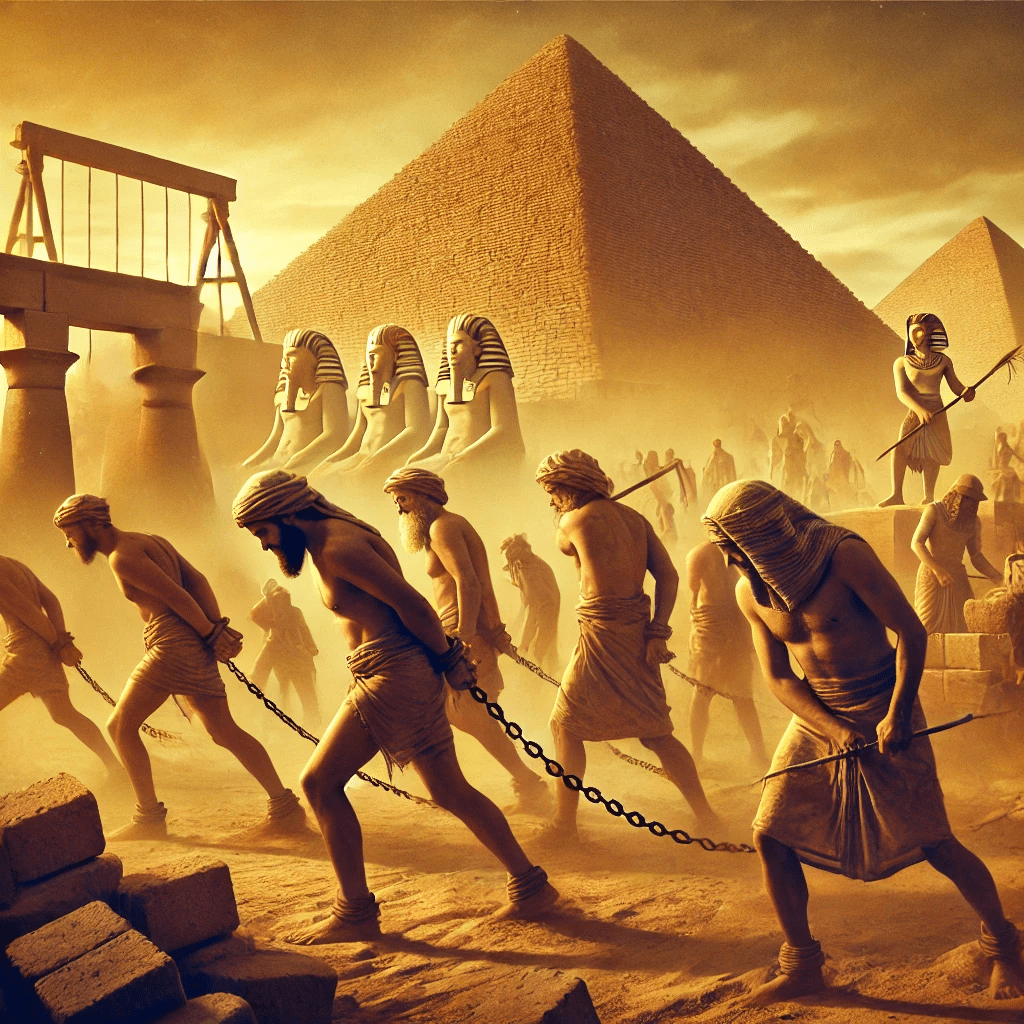
Whenever I feel the weight of deep suffering in my life—when the questions are louder than the answers and hope seems far—I try to imagine what it would have been like to live during the 400 years of Israelite bondage in Egypt. I picture the burning sun overhead, the endless days of grueling slave labor, and the absence of rest. There was no Sabbath yet—Moses hadn’t arrived. The law wasn’t given. The only thing I would have to cling to was a faint promise passed down from generations: that God would send a Deliverer. That one day, the land promised to our forefather Abraham would be ours. But until then, it was just the desert heat and the weight of chains. And yet, somehow, that promise sustained them—and it sustains me, too.
The Reality of Bondage
The Israelites lived under the heavy burden of Egyptian oppression for centuries. Generation after generation knew nothing but slavery. They woke up to the crack of whips, worked under the unforgiving sun, and fell asleep with calloused hands and aching bodies. There was no respite, no break, no weekend. The idea of a “Sabbath” didn’t exist yet. Their suffering was not brief or occasional; it was systemic and generational.
For many of us, suffering may not look like physical slavery, but it often feels like we are shackled. We live through seasons where it seems like God is silent, and hope is distant. Emotional pain, financial struggles, relational breakdowns, chronic illness—these burdens press down on us. We begin to wonder if God sees, if He hears, or if He remembers.
The Long Wait for a Promise
God had made a covenant with Abraham long before the Israelites ever entered Egypt. He promised Abraham a land, a nation, and a blessing that would reach the entire world (Genesis 12:1-3). But in Genesis 15:13-16, God also made it clear that the fulfillment of that promise would not come quickly:
“Know for certain that your offspring will be sojourners in a land that is not theirs and will be servants there, and they will be afflicted for four hundred years. But I will bring judgment on the nation that they serve, and afterward they shall come out with great possessions… for the iniquity of the Amorites is not yet complete.”
There is a staggering weight to those words: “not yet complete.” God was not only working on behalf of His people, but also weaving together justice for the land they would one day inhabit. The Israelites suffered while the sin of another people group reached its fullness. This is not a comfortable truth, but it is a divine one: sometimes our suffering is interwoven with a plan we cannot see, bound up in justice and mercy that are being timed with divine precision.
God Does Not Forget
Exodus 2:23-25 gives us a glimpse into God’s heart in the midst of long suffering:
“The people of Israel groaned because of their slavery and cried out for help. Their cry for rescue from slavery came up to God. And God heard their groaning, and God remembered his covenant with Abraham, with Isaac, and with Jacob. God saw the people of Israel—and God knew.”
That final phrase, “and God knew,” is one of the most comforting in all of Scripture. God’s knowledge is not detached. He doesn’t just observe—He enters in, He acts, and He delivers. And in His perfect timing, He raised up Moses to lead His people out of bondage. The deliverer came, just as He promised.
And centuries later, another Deliverer would come—the greater Moses, Jesus Christ. He didn’t just lead us out of physical slavery, but out of bondage to sin and death. His kingdom has been established, and though we wait for its fullness, the promise has already begun to unfold.
Christian Suffering Today
We still walk through wilderness seasons. We still feel the sting of unanswered prayers, the fatigue of carrying burdens that seem to have no end. But Christian suffering is never purposeless. It is shaped by a narrative of redemption. We don’t just suffer in silence; we suffer in hope.
When I feel stuck in the middle of a season that makes no sense, I try to remind myself: Abraham didn’t see the promised land fulfilled in his lifetime. The Israelites waited generations. Yet God was faithful. Always faithful. The same God who heard their groaning hears ours.
In our trials, we have the benefit of looking back on the full arc of God’s redemptive plan. We know how the story plays out. Jesus came. The Spirit dwells in us. The kingdom is here and still coming. That doesn’t take away the pain, but it infuses it with meaning and hope.
Encouragement for the Journey
If you’re walking through a season of suffering right now, I want to encourage you with this: God is not blind to your pain. He sees. He hears. He knows. Just as He remembered His covenant with Abraham, He remembers the promises He’s made to you in Christ.
The path may not be clear. The future might look uncertain. But we serve a God who fulfills every word He has spoken. Moses came. Jesus came. The promises have not failed, and they never will.
So hold on. Keep trusting. Your suffering is not the end of the story—it may very well be the soil in which God’s deepest work is being done. Trust in His providence, even when you can’t yet see the deliverance. Because it’s coming. It always does.
 Reformed Faith Insights