
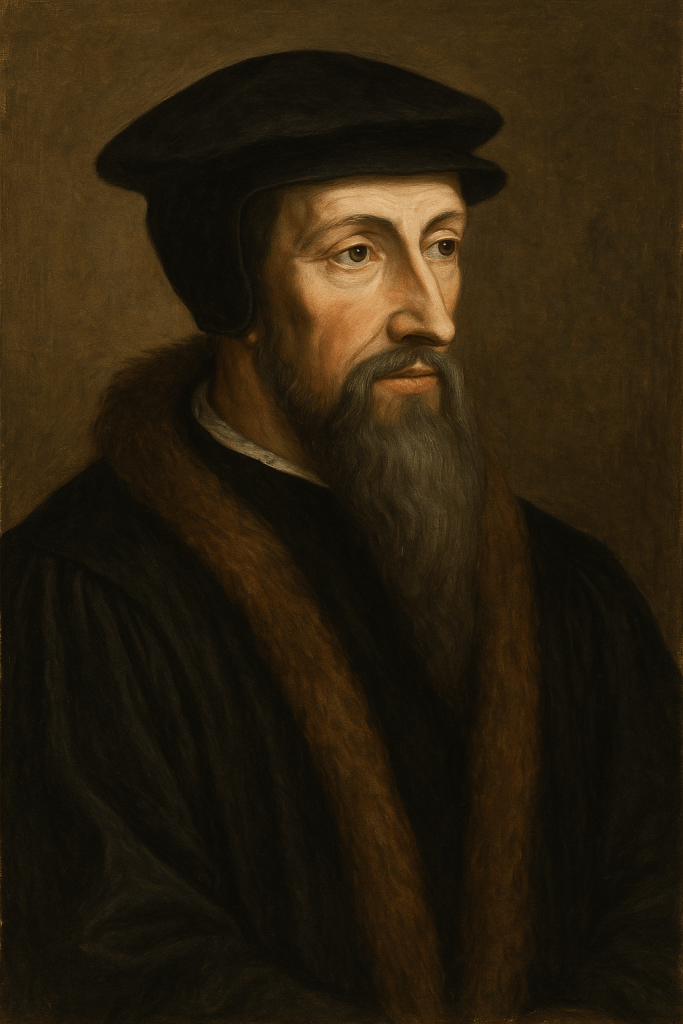
Remembering John Calvin: The Legacy of a Reformer Born for the Church and the World

I. Introduction – A Birthday Worth Remembering

On July 10, 1509, in the small cathedral town of Noyon, France, a child was born who would grow to become one of the most influential theologians and church reformers in the history of Christianity—John Calvin. Though his life would be marked by exile, controversy, and sickness, Calvin’s relentless pursuit of God’s truth would shape not only the course of the Protestant Reformation, but also the worship, polity, and doctrine of countless churches around the world. On the anniversary of his birth, we do well to pause, not to glorify the man, but to give thanks to God for the ways He used a humble scholar from northern France to ignite theological clarity and spiritual renewal that still resonates centuries later.

Calvin’s theological system is best known through his magnum opus, The Institutes of the Christian Religion—a work that he first published at the age of 26 and continued to revise throughout his life until the definitive edition of 1559. But Calvin was more than a theologian; he was a pastor, a biblical commentator, and above all, a servant of Christ’s church. He insisted that theology must never be abstract but always devotional and practical: “True and sound wisdom consists of two parts: the knowledge of God and of ourselves” (Battles ed., Institutes, 1.1.1). This reciprocal knowledge—of who God is and who we are in relation to Him—forms the heartbeat of Calvin’s spiritual vision.

Even in the opening lines of the Institutes, Calvin displays a deep humility before the majesty of God. “Without knowledge of self,” he writes, “there is no knowledge of God” (Beveridge ed., Institutes, 1.1.1). Yet he is quick to reverse the mirror: “It is evident that man never attains to a true self-knowledge until he has previously contemplated the face of God, and come down after such contemplation to look into himself” (Beveridge ed., Institutes, 1.1.2). For Calvin, the knowledge of God is not a cold academic pursuit, but a furnace that refines and humbles. We behold the holiness of God, and then see how stained and needy we are in contrast.

Calvin’s theology is often misrepresented as dry, distant, and austere. Yet those who take time to read him will encounter someone deeply committed to the warmth of divine love and the assurance of God’s grace. Calvin writes, “Our being should not be under the dominion of ourselves, but we should live entirely to the Lord and die to him” (Battles ed., Institutes, 3.7.1). From this, the Christian life becomes not a rigid checklist of doctrine, but a responsive life of joyful obedience rooted in love for God.

His pastoral vision extended far beyond academic theology. Calvin spent his life building up the church in Geneva, despite multiple exiles, illnesses, and opposition. He preached sermons daily, taught students, visited the sick, and labored for the moral and spiritual renewal of the city. One of his most powerful legacies is not just what he taught, but how he lived under the Lordship of Christ. “We are not our own,” he writes, “therefore, let us live for him and die for him” (Beveridge ed., Institutes, 3.7.1).

And yet, Calvin’s own awareness of human weakness and divine sovereignty kept him grounded. He described the human heart as “a perpetual forge of idols” (Beveridge ed., Institutes, 1.11.8) and pointed readers constantly away from their own works to rest in the finished work of Christ. “Until men recognize that they owe everything to God,” he writes, “that they are nourished by his fatherly care, that he is the Author of their every good—until they humble themselves completely and strip themselves of all self-confidence—they will never give him his due” (Battles ed., Institutes, 1.1.1).

So, on this July 10th, we remember John Calvin not as a flawless man or a distant intellectual, but as a faithful servant of Christ who labored so that others might see the greatness of God. As he once prayed, “I offer my heart to you, O Lord, promptly and sincerely.” That motto—Cor meum tibi offero, Domine, prompte et sincere—still echoes today. May his life invite us to deeper reverence, humility, and faith in our sovereign and gracious God.

II. Calvin the Theologian: Institutes and a Vision of God’s Glory

If Martin Luther cracked open the door of the Reformation, John Calvin stepped through it and built a theological house to dwell in. His Institutes of the Christian Religion is not only the most influential Reformed work of systematic theology, but one of the most enduring and expansive theological texts in the history of the church. Written originally in 1536 and revised over two decades until its final form in 1559, the Institutes was Calvin’s attempt to give “a sum of piety” and a “doctrine that is necessary to know” (Battles ed., Prefatory Address). It was, in Calvin’s words, “a key to open a way for all children of God into a right and true understanding of Holy Scripture” (Beveridge ed., Prefatory Address).

From the first page to the last, Calvin’s theology revolves around one central aim: the glory of God in the salvation of sinners. The famous opening lines declare that “true and sound wisdom consists of two parts: the knowledge of God and of ourselves” (Battles ed., Institutes, 1.1.1). This twofold knowledge sets the framework for everything that follows. God is sovereign, holy, and utterly self-sufficient; man is fallen, needy, and dependent. Theology, then, is not an abstract science, but a practical discipline meant to drive the heart into awe, reverence, and trust.

Calvin’s emphasis on the sovereignty of God is one of the defining marks of his theology. This does not begin with the controversial doctrine of predestination, but with the very nature of God as Creator and Sustainer of all things. “Nothing is more absurd,” Calvin writes, “than that anything should be done without God’s ordination, because it happens against his will” (Beveridge ed., Institutes, 1.16.6). Providence is not a cold determinism, but the comforting assurance that not even a sparrow falls apart from the Father’s hand.

In matters of salvation, Calvin’s theological clarity is most vibrant. He saw man as spiritually dead apart from grace, incapable of seeking God or choosing righteousness on his own. “Original sin,” Calvin writes, “seems to be a hereditary depravity and corruption of our nature” which renders us “obnoxious to God’s wrath” (Battles ed., Institutes, 2.1.8). Yet it is in this helpless state that the mercy of God shines brightest. Election, for Calvin, is not a theological abstraction but a testimony of divine love: “God has adopted us once for all in order that we may persevere to the end” (Battles ed., Institutes, 3.21.7).

Calvin’s doctrine of union with Christ brings warmth and cohesion to his soteriology. Every saving benefit—justification, sanctification, adoption—is received in Christ and through the Spirit. “As long as Christ remains outside of us,” Calvin insists, “and we are separated from him, all that he has suffered and done for the salvation of the human race remains useless and of no value to us” (Battles ed., Institutes, 3.1.1). Faith is the Spirit-given bond that unites the believer to Christ, and this union is both legal (justification) and transformative (sanctification).

Far from promoting a dry orthodoxy, Calvin taught that true theology always issues in piety, which he defined as “that reverence joined with love of God which the knowledge of his benefits induces” (Battles ed., Institutes, 1.2.1). The goal of doctrine is not simply to inform but to ignite the heart. Theology is not merely for the scholar but for the worshiper. “It is evident,” Calvin writes, “that man never attains to a true self-knowledge until he has previously contemplated the face of God” (Beveridge ed., Institutes, 1.1.2). To know God rightly is to be changed by Him inwardly.

The scope of the Institutes is enormous—covering topics from Scripture’s authority, to the Trinity, to civil government—but it is always tethered to one central concern: that God be honored and glorified, and that sinners find refuge in Christ. Whether Calvin is describing the majesty of God’s law or the depths of the atonement, he writes with a pastor’s heart and a theologian’s mind. He leaves no room for self-confidence, but points again and again to the sufficiency of Christ and the majesty of grace.

In a world often intoxicated with autonomy and self-justification, Calvin’s vision remains radically God-centered. “Man is so blinded by pride,” he writes, “that he counts himself sufficient to obtain righteousness” (Beveridge ed., Institutes, 3.12.2). But Calvin knew better, and he called the church to look upward—to the sovereign God, to the crucified Christ, to the Spirit who gives life. That vision, born in the pages of the Institutes, still gives light to pilgrims who long to see the face of God.

III. Calvin’s Ecclesiology: A Church Reformed and Always Reforming

For John Calvin, the doctrine of the church was not an afterthought but a vital branch of Christian theology. He believed that God’s redemptive work in the world was not merely individual but corporate—centered in the visible body of Christ, the church militant on earth. As one who labored tirelessly for ecclesiastical reform in Geneva, Calvin saw the reformation of the church as the necessary outworking of the gospel’s renewal. The purified preaching of the Word and the right administration of the sacraments were, for him, not just ecclesial duties—they were marks of the true church.

Calvin famously defined the church in these terms:

“Wherever we see the word of God purely preached and heard, and the sacraments administered according to Christ’s institution, there, it is not to be doubted, a church of God exists.” (Battles ed., Institutes, 4.1.9)

This twofold standard—Word and sacrament—was Calvin’s measuring rod for authentic Christian community. He rejected both the spiritual individualism that severed Christians from the visible church and the corrupted institutionalism of the medieval church, which had obscured the gospel with superstition and abuse. In Geneva, he sought to restore the church to biblical fidelity, not by innovation, but by recovery—a return to apostolic simplicity and purity.

One of Calvin’s most significant contributions to ecclesiology was his reformation of church government. He taught that Christ alone is the Head of the church, and under Him are four offices established for its upbuilding: pastors, teachers (doctors), elders, and deacons. These roles were grounded in Scripture, particularly in Ephesians 4 and 1 Timothy 3. Calvin resisted any form of hierarchy that elevated one office above the rest—especially the monarchical papacy—calling it a “tyranny” inconsistent with the New Testament church.

“There is no other rule for the right government of the church than that which he [Christ] has laid down in his word.” (Beveridge ed., Institutes, 4.8.9)

The pastors were responsible for preaching and administering the sacraments; the teachers ensured doctrinal integrity; the elders oversaw the moral and spiritual conduct of the flock; and the deacons cared for the poor and needy. Calvin’s Geneva Consistory, made up of pastors and elders, exercised church discipline, not to tyrannize consciences, but to maintain the holiness of the church and shepherd straying sheep back to Christ.

Church discipline, in Calvin’s view, was not optional but essential. He wrote:

“As the saving doctrine of Christ is the soul of the church, so discipline forms the ligaments which connect the members together, and keep each in its proper place.” (Beveridge ed., Institutes, 4.12.1)

He understood discipline as both corrective and restorative—an expression of love, not legalism. A church that failed to practice discipline would, in Calvin’s mind, quickly become spiritually diseased and indistinguishable from the world. “Discipline,” he warned, “is like a bridle to restrain and tame those who rage against the doctrine of Christ” (Battles ed., Institutes, 4.12.1).

The Lord’s Supper, too, held a central place in Calvin’s ecclesiology. While rejecting Roman transubstantiation and Lutheran consubstantiation, Calvin taught that believers are truly nourished by the real spiritual presence of Christ through faith. The Supper is not a bare symbol, but a means of grace, binding the church together in union with Christ. As Calvin wrote:

“The sacred mystery of the Supper consists in the spiritual reality of that communion which we have with Christ in his flesh and blood, and with all his members.” (Battles ed., Institutes, 4.17.1)

For Calvin, the visible church was not perfect, but it was necessary. “The church is the mother of all believers,” he declared, “for there is no other way to enter into life unless she conceive us in her womb, give us birth, nourish us at her breast, and lastly…keep us under her care and guidance” (Battles ed., Institutes, 4.1.4). Though plagued with faults, the church remains God’s chosen instrument to proclaim the gospel, train disciples, and extend the kingdom.

This ecclesiological vision became foundational to Presbyterian polity and Reformed churches worldwide. Its genius was in balancing local authority with biblical accountability, structure with spiritual vitality. Calvin’s model aimed to recover not just doctrinal purity, but also pastoral care and community holiness—reforming the church according to the Word of God.

In our fragmented age, Calvin’s vision is a call to recover the high view of the church as Christ’s body, governed by His Word, sustained by His grace, and reformed continually by His Spirit. The ecclesia reformata semper reformanda—“the church reformed and always reforming”—is not a slogan of progressivism, but a commitment to ongoing repentance and fidelity to Scripture.

IV. Calvin and the Dutch Reformed Tradition

Though John Calvin never stepped foot in the Netherlands, his theological vision became the bedrock of Dutch Reformed Christianity for generations. His influence in the Low Countries was not merely intellectual—it was deeply ecclesiastical, political, and spiritual. Through his writings, students, and the spread of Reformed confessions, Calvin’s theology shaped the identity of a people who would become known for their commitment to doctrinal clarity, personal piety, and confessional fidelity.

The Dutch Reformation, like other Protestant movements, began as a response to the theological and moral corruption of the medieval church. But while Lutheranism made early inroads, it was Calvinism that ultimately captured the Dutch heart. What drew the Dutch to Calvin’s thought was not just his doctrine of predestination or his critique of Rome, but his robust vision of God’s sovereignty over every sphere of life—a vision particularly compelling in a nation struggling for religious and political freedom under Catholic Spain.

Calvin’s Geneva Academy played a pivotal role in training future Dutch ministers and theologians. Students such as Zacharias Ursinus, Caspar Olevianus, and Franciscus Junius carried Calvin’s theology back to the Netherlands, where they became instrumental in shaping the early Reformed churches. The Dutch quickly developed their own expressions of Calvinistic thought, culminating in the Three Forms of Unity: the Belgic Confession (1561), the Heidelberg Catechism (1563), and the Canons of Dort (1619). Each of these documents bears the clear imprint of Calvin’s theology—especially in its view of Scripture, the church, human depravity, and divine election.

The most defining moment of Calvin’s impact in the Netherlands came with the Synod of Dort (1618–1619). This international Reformed council was convened to respond to the rise of Arminianism, a movement that challenged Calvin’s teachings on grace and predestination. The Synod reaffirmed the doctrines Calvin championed, particularly unconditional election, limited atonement, and irresistible grace—forming what would later be remembered as the Five Points of Calvinism or TULIP.

Although Calvin never systematized his theology into five points, his Institutes contain the heart of these doctrines. Regarding election, he wrote:

“We say, then, that Scripture clearly proves this much, that God by his eternal and immutable counsel determined once for all those whom he would one day admit to salvation, and those whom he would condemn to destruction.” (Beveridge ed., Institutes, 3.21.7)

Calvin did not present election as a cold decree, but as a source of assurance and worship. He emphasized that election is rooted not in human worthiness but solely in God’s mercy and purpose:

“If we are elected in Christ, we shall find in him the assurance of our election.” (Battles ed., Institutes, 3.24.5)

The Dutch Reformed churches adopted this Christ-centered understanding of predestination, maintaining a strong sense of God’s covenant love and the believer’s security in Christ.

Calvin’s influence also extended to church polity and liturgy in the Netherlands. Dutch Reformed churches followed a Presbyterian model of governance, with ministers and elders sharing responsibility in consistories. Worship services centered on preaching, prayer, psalm singing, and the sacraments—echoing Calvin’s desire for simplicity and biblical faithfulness. “God disapproves all modes of worship not expressly sanctioned by his Word,” Calvin warned (Beveridge ed., Institutes, 4.10.23). The Dutch heeded that warning, developing a liturgy that was reverent, didactic, and saturated with Scripture.

Calvin’s understanding of the Christian life also resonated with the Dutch. His call to live “coram Deo”—before the face of God—was not confined to the church pew but extended into the home, the marketplace, and the government. This worldview would later give rise to a distinctively Reformed cultural vision championed by Dutch theologians like Abraham Kuyper, who famously declared, “There is not a square inch in the whole domain of our human existence over which Christ, who is Sovereign over all, does not cry, ‘Mine!’”

In Calvin’s words:

“The Lord bids each one of us in all life’s actions to look to his calling. For he knows with what great unrest the human mind is borne hither and thither… So that no one may thoughtlessly transgress his limits, he has named these various kinds of living ‘callings.’” (Battles ed., Institutes, 3.10.6)

This doctrine of vocation—rooted in Calvin’s theology—took deep root in the Netherlands, producing generations of believers committed to faithfulness in both church and society.

Today, Dutch Reformed theology continues to shape churches across the world, from the Netherlands to South Africa, from Canada to the United States. While the landscape of Reformed churches has diversified, the DNA of Calvin’s Geneva remains unmistakable. His vision for a church under the Word, a life lived before God, and a kingdom extending into every area of life continues to animate and guide faithful believers across the centuries.

V. Calvin’s Spiritual Legacy Among the English Puritans and Scottish Presbyterians

Though John Calvin’s ministry was rooted in Geneva, his influence surged beyond the borders of continental Europe—especially into England, Scotland, and eventually America. The English Puritans and the Scottish Presbyterians adopted and adapted Calvin’s theology, shaping movements that would impact the course of Christian history for centuries. In them, Calvin found not only eager readers but spiritual heirs—men and women who embraced his theology of God’s sovereignty, covenantal worship, and a life lived under the lordship of Christ.

Calvin’s relationship to the English Reformation was both direct and providential. During the reign of Mary I (“Bloody Mary”), many English Protestants fled persecution and found refuge in Geneva. These Marian exiles—including John Knox and others—were exposed firsthand to Calvin’s ecclesiastical reforms and theological writings. When they returned to England under Elizabeth I, they brought with them not just ideas, but a vision: a purified church governed by the Word of God alone.

The Puritans, as they came to be known, were not a monolith but a movement marked by zeal for biblical fidelity. They longed to see the Church of England further reformed in worship, doctrine, and discipline. Calvin’s Institutes provided them with a comprehensive theological framework rooted in Scripture and aimed at producing a godly people. His doctrine of total depravity, effectual calling, and covenantal obedience were all embraced and preached from English pulpits. One Puritan minister declared that the Institutes was the “greatest work written since the days of the apostles.”

Calvin’s understanding of the Christian life as one of ongoing repentance and sanctification resonated with Puritan spirituality. He wrote:

“The whole life of Christians ought to be a sort of practice of godliness.” (Beveridge ed., Institutes, 3.6.5)

The Puritans adopted this ethos wholeheartedly, emphasizing family worship, Sabbath observance, self-examination, and spiritual disciplines—not as legalism, but as the outworking of a regenerate heart. The Puritan mind, while scholastic in training, was deeply pastoral. They sought what Calvin called the experientia of grace—the lived experience of Christ’s sanctifying work through Word and Spirit.

In Scotland, Calvin’s legacy was most visibly realized through John Knox, a fiery reformer who spent time in Geneva under Calvin’s tutelage. Knox called Geneva “the most perfect school of Christ that ever was on the earth since the days of the apostles.” Upon returning to Scotland, Knox helped establish a national church modeled closely after Calvin’s vision: eldership rule, simple liturgy, expository preaching, and a high view of God’s sovereign grace.

This gave birth to Scottish Presbyterianism, which enshrined many of Calvin’s principles into enduring institutional forms. The First Book of Discipline (1560) and the Second Book of Discipline (1578) reflected Calvin’s influence in church polity and doctrine. But perhaps the fullest flowering came in the Westminster Assembly (1643–1653), where English and Scottish theologians crafted the Westminster Confession of Faith—a document deeply Calvinistic in tone and structure.

Calvin’s theology of God’s sovereign grace was at the heart of Westminster’s statements on predestination, justification, sanctification, and perseverance. The Assembly echoed his understanding that salvation is entirely by divine mercy:

“As Scripture, when it speaks of our free election, removes all merit on our part, so it enjoins humility, and deprives man of all pretext for glorying.” (Battles ed., Institutes, 3.21.2)

The English Puritans and Scottish Presbyterians did not worship Calvin. But they saw in him a guide—a shepherd-theologian who had faithfully taught the Word of God and called the church to holiness. They passed his theology on to future generations, including the American Puritans, who planted Calvinistic doctrine deep into the soil of New England. Preachers like Jonathan Edwards carried the torch forward, preaching the majesty of God and the weight of eternal things with Calvin’s deep sense of reverence.

Even today, Calvin’s fingerprints are visible in Reformed confessions, Presbyterian polity, and Reformed seminaries across the world. Wherever Christ is preached with awe, and the Scriptures are held in highest esteem, Calvin’s legacy quietly endures. As he wrote near the end of his Institutes:

“Let us not cease to do the utmost, that we may incessantly go forward in the way of the Lord… until we shall at length arrive at the goal.” (Beveridge ed., Institutes, 3.6.5)

Calvin never desired to be known as a reformer, but as a humble servant of the Word. And in the Puritans and Presbyterians, we see the fruit of that humble obedience—a church reformed by the Scriptures and aflame with a passion for the glory of God.

VI. Calvin’s Broader Cultural and Ecumenical Impact

John Calvin is best known as a theologian of grace and a reformer of the church, but his impact reaches far beyond the pulpit or the seminary. His influence has permeated realms as varied as education, politics, economic theory, and global Christianity. He was a man of the Word, to be sure—but his vision of God’s sovereignty over all of life made him a forerunner of what we now call a Christian worldview. Calvin believed that all creation belongs to God, and that every domain of human endeavor must come under Christ’s lordship. In this way, his legacy is not only ecclesial but cultural—and not only Reformed but ecumenical.

Calvin’s doctrine of providence undergirded his view of the world as an ordered, purposeful creation governed by God’s sovereign hand. He wrote:

“The Lord has so knit together the order of the world, that nothing can be done without his will or permission.” (Beveridge ed., Institutes, 1.16.6)

Far from promoting fatalism, this conviction gave Calvin confidence that every part of life—science, labor, law, and art—had meaning under the reign of Christ. This notion would later fuel Protestant work ethic theories, particularly in sociologist Max Weber’s famous thesis that Calvinism contributed to the rise of capitalism by dignifying secular work as a calling (Beruf).

But Calvin was not an economist; he was a pastor and theologian who saw all of life as “coram Deo”—before the face of God. In this light, work, study, and civic duty were all to be performed with reverence and responsibility. He declared:

“The Lord bids each one of us in all life’s actions to look to his calling… so that no one may thoughtlessly transgress his limits.” (Battles ed., Institutes, 3.10.6)

This doctrine of vocation elevated the ordinary. Calvin taught that the farmer behind his plow and the magistrate behind his desk both served Christ as meaningfully as the preacher in his pulpit, provided they acted in faith and obedience.

Calvin also placed a strong emphasis on education, founding the Geneva Academy in 1559 to train both ministers and lay leaders in the Word of God. Literacy was central, since the people of God needed to read Scripture for themselves. This emphasis helped usher in a culture of learning and critical thinking across Protestant Europe. In time, Reformed schools, universities, and seminaries were established throughout the world—from Princeton and Yale in America to Stellenbosch in South Africa.

In terms of politics, Calvin’s legacy is complex but significant. He was not a champion of popular sovereignty, but his insistence that all human authority is derived from God and accountable to Him laid the theological groundwork for resistance to tyranny and the rise of constitutional governance. Calvin insisted:

“We are subject to the men who rule over us, but only in the Lord; if they command anything against Him, let us not pay the least regard to it.” (Beveridge ed., Institutes, 4.20.32)

This principle—known as the doctrine of lesser magistrates—was later employed by Reformed resistance movements across Europe and helped influence early American political thought, particularly among Calvinist dissenters.

Perhaps most surprisingly, Calvin’s influence reaches into ecumenical Christianity as well. Though his theology was distinctively Reformed, his emphasis on Scripture, grace, and the majesty of God has resonated with Christians from diverse traditions. In the 20th and 21st centuries, Calvin has been read not only by Presbyterians and Dutch Reformed churches, but by Baptists, Anglicans, Methodists, and even Roman Catholics. The rise of evangelical Calvinism in recent decades—seen in the ministries of figures like J.I. Packer, R.C. Sproul, and John Piper—demonstrates that Calvin’s voice still speaks powerfully to a global audience hungry for doctrinal depth and spiritual integrity.

Moreover, many Reformed churches in the Global South—particularly in Africa, Asia, and Latin America—trace their theological lineage to Calvin, either through missionary influence or indigenous adoption. These churches are now among the fastest-growing segments of the global church. In 2010, more than 80 million believers belonged to the World Communion of Reformed Churches, a testimony to Calvin’s global reach.

And yet, Calvin himself would be the last to seek credit. He labored not to exalt his name, but to exalt the name of Christ. As he wrote:

“We should consider that the principal end of our lives is to be so reconciled to God, and to devote ourselves wholly to him, that his glory may shine forth in us.” (Beveridge ed., Institutes, 3.6.6)

In every generation, Calvin calls the church back to God-centered worship, grace-filled theology, and lives lived for the glory of Christ in every sphere. That is why, even five centuries later, his vision continues to inspire and shape the global church—ever reformed, ever reforming.

VII. Why We Still Need John Calvin

In an age defined by theological confusion, spiritual consumerism, and institutional instability, the life and legacy of John Calvin remain remarkably relevant. Born over five hundred years ago, Calvin was not interested in novelty, popularity, or building a personal brand. He was captivated by the majesty of God, the authority of Scripture, and the glory of Christ in the church. And he labored—quietly, often painfully—for the rest of his life so that the truth of God might reign in the hearts of His people. Today, we still need John Calvin—not because he was perfect, but because he was faithful.

Calvin reminds us that theology is not a mere intellectual exercise but a matter of life and death. He begins his Institutes by showing that true wisdom begins with knowing God and knowing oneself rightly:

“Our wisdom, in so far as it ought to be deemed true and solid wisdom, consists almost entirely of two parts: the knowledge of God and of ourselves.” (Battles ed., Institutes, 1.1.1)

In an age obsessed with self-expression and self-fulfillment, Calvin redirects our gaze upward. We are not autonomous individuals floating in a meaningless cosmos; we are creatures made by a holy God, corrupted by sin, and in need of redemption. The recovery of this twofold knowledge—of God’s majesty and man’s misery—is as vital today as it was in Calvin’s time.

Calvin also reminds us that the church matters. In a world where church attendance is declining and institutional distrust is on the rise, Calvin’s robust vision of the visible church stands as a countercultural testimony. The church, he insists, is the mother of believers, the household of faith, and the place where God nourishes His people:

“There is no other way to enter into life unless she [the church] conceive us in her womb, give us birth, nourish us at her breast, and lastly…keep us under her care and guidance.” (Battles ed., Institutes, 4.1.4)

His commitment to preaching, sacraments, discipline, and godly leadership is not about control but care—about forming a people devoted to God and conformed to Christ.

Perhaps most importantly, Calvin reminds us of the supremacy of God’s grace. In his view, salvation is not the result of our striving or achievements but the free mercy of a sovereign God. This was not cold fatalism—it was the burning center of Christian assurance and joy. “We are elected in Christ,” Calvin wrote, “and we shall find in him the assurance of our election” (Battles ed., Institutes, 3.24.5). Far from producing arrogance, this truth should lead to humility and worship. As Calvin put it:

“Let us not be ashamed to be ignorant in something, or not to succeed in everything. Let us be content to be learners in Christ’s school until the end.” (Beveridge ed., Institutes, Prefatory Address)

This is why Calvin’s legacy lives on. He did not set out to build a movement; he sought only to be faithful to the Word of God. Yet his vision reshaped nations, emboldened reformers, instructed generations of believers, and gave the church a theological foundation that still stands today.

Calvin’s personal motto, which he used in correspondence and had engraved in his heart, was this:

“Cor meum tibi offero, Domine, prompte et sincere”—“I offer my heart to you, O Lord, promptly and sincerely.”

That is a fitting summary of his life. Not self-centered ambition, but joyful surrender. Not innovation for its own sake, but faithfulness to God’s Word. Calvin’s enduring relevance is found not in the age of his books, but in the timelessness of the truth he taught. And though he is often caricatured as austere or severe, those who read him with care will discover a man full of pastoral tenderness and spiritual insight.

So on this July 10th, let us remember John Calvin not as a distant relic of the past, but as a gift of Christ to His church. Let his words reawaken our awe of God. Let his vision rekindle our love for Scripture. Let his example encourage us to live sincerely, courageously, and reverently—before the face of God, in the power of His grace, and for the glory of His name.

“For since we are not our own, in so far as we can, let us forget ourselves and all that is ours.”
—John Calvin (Beveridge ed., Institutes, 3.7.1)

Soli Deo Gloria.

Breaking the Table of False Assurance: A Response to the Legacy Behind Sinners in the Hands of an Angry God

On July 8th, 1741, Jonathan Edwards delivered what would become the most famous sermon in American history—Sinners in the Hands of an Angry God. It has been memorialized in textbooks as a quintessential fire-and-brimstone message, one of terror and trembling. But what’s often overlooked is why Edwards felt compelled to preach such a piercing word of warning.

This sermon was not merely about evoking fear. It was a desperate plea from a pastor who had inherited a congregation steeped in false assurance. That assurance had a name and a history—it began with Edwards’ own grandfather, Solomon Stoddard. Stoddard was a towering figure in New England’s religious life, and one of his most controversial legacies was the promotion of what might be called “communion table conversion.” He taught that the Lord’s Supper was not only a means of grace for the converted, but a tool to awaken faith in the unconverted. For Stoddard, the table was open to all, even those who gave no evidence of regeneration.

This theological experiment planted seeds of spiritual complacency. Instead of preaching repentance and the new birth, many ministers under Stoddard’s influence extended the sacraments to unrepentant hearts. Church membership and table fellowship became cultural inheritances, not covenantal realities. In short, people were told they belonged to Christ without being born again.

Jonathan Edwards would not have it.

When Edwards stepped into the pulpit on that hot July day, he did so to awaken a people lulled to sleep by ritual and sentimentality. Sinners in the Hands of an Angry God was not a random burst of Puritan wrath—it was a surgical strike against generations of theological compromise. It was a call to true conversion, to flee from the wrath to come and lay hold of Christ by faith—not by presumption.

In this post, I want to trace the roots of this problem, expose its modern equivalents, and renew the call to guard the Lord’s Table with reverence, as Scripture commands.

II. The Stoddardian Legacy: A Faulty Foundation

To understand the urgency and weight of Jonathan Edwards’ ministry, we must look backward—not just to Scripture, but to the spiritual inheritance he received from his grandfather, Solomon Stoddard. Stoddard served as pastor of Northampton’s Congregational Church for over 60 years and was one of the most influential religious figures in colonial New England. His towering presence shaped not only the ecclesiology of his local congregation, but also the theological climate of the region.

But beneath his reputation for revivalism lay a troubling innovation: the opening of the Lord’s Supper to the unconverted. Stoddard taught that the sacraments could function as “converting ordinances”—that participation in communion could lead to, or even result in, a person’s saving faith. This marked a significant departure from the historic Reformed understanding, which reserved the table for those who had already professed faith and shown signs of regeneration.

What followed was a widening of the church’s gates without a corresponding call to the narrow path of repentance and faith. Baptized individuals, many without any credible testimony of conversion, were encouraged to partake of the Supper. Stoddard himself claimed to have been converted at the communion table—an experience that gave theological legitimacy to his practice. But this personal testimony, however sincere, was elevated to ecclesial policy, creating generations of churchgoers who confused sacramental participation with saving grace.

The result was tragic: a church culture where many presumed they were safe simply because they were present. Assurance of salvation was no longer tethered to the inward work of the Spirit, but to outward observance. The Lord’s Table, intended as a memorial for the redeemed, had become an altar for the unregenerate.

By the time Jonathan Edwards assumed leadership of the Northampton church, he found himself preaching to a congregation largely inoculated against the gospel by Stoddard’s innovations. The spiritual complacency he faced was not accidental—it was inherited. And Edwards, with pastoral courage and deep reverence for the holiness of God, saw that revival would not come without first dismantling the very system his grandfather had built.

III. Edwards’ Inheritance: A Congregation Needing Awakening

When Jonathan Edwards stepped into pastoral leadership at Northampton in 1729, he was not merely filling the pulpit of his grandfather—he was inheriting a deeply ingrained theological system that blurred the lines between the church and the world. His people were respectable, religious, and devout in appearance. But behind their churchgoing rhythm was a dangerous spiritual slumber, born from years of false assurance rooted in routine sacramentalism.

Edwards did not step into that pulpit as a revolutionary firebrand. In fact, his early years were marked by careful, thoughtful preaching focused on God’s holiness, man’s sinfulness, and the necessity of the new birth. But over time, it became clear that the sheepfold he tended was filled with many who had never been truly born again. They had been catechized, baptized, and brought to the table—many since childhood—but without any evidence of regeneration. Edwards recognized that their greatest danger was not outright rebellion, but unexamined presumption.

This conviction came to a head on July 8, 1741, when Edwards delivered Sinners in the Hands of an Angry God in Enfield, Connecticut—though its thunderclap echoed in Northampton. The sermon wasn’t random fire-and-brimstone rhetoric; it was the spiritual defibrillator his people needed. With vivid imagery and biblical gravity, Edwards portrayed the precariousness of life apart from Christ: sinners dangling by a thread over the fires of God’s righteous judgment.

But what made this sermon so controversial—then and now—was its audience. Edwards wasn’t preaching to pagans; he was preaching to covenant children, pew-sitters, moralists, and table-partakers. He saw that many of them were relying on outward signs rather than inward renewal. He was calling them to examine themselves—not merely for formality’s sake, but for their souls’ salvation.

His pastoral task was not to uphold tradition but to expose the error within it. Edwards loved his people enough to trouble their consciences. He longed for them to exchange empty ritual for authentic repentance. In confronting the spiritual lethargy of his congregation, he was not undermining his grandfather’s legacy to be spiteful—he was attempting to restore biblical fidelity where sentimental theology had taken root.

Revival, in Edwards’ view, would never come by softening the truth. It would come only when sinners awoke to their true condition and fled to Christ—not a cup of wine—for mercy.

IV. The Half-Way Covenant and Its Modern Descendants

To fully grasp the danger Jonathan Edwards confronted, one must consider the theological soil from which it grew: the Half-Way Covenant. Introduced in 1662, this compromise was born of pastoral anxiety. As fewer second-generation Puritans professed saving faith, ministers faced a dilemma—either withhold the sacraments from an increasing number of baptized children, or redefine what church membership meant.

Many chose the latter.

The Half-Way Covenant permitted baptized, yet unconverted, individuals to become partial church members and have their own children baptized. It was a theological concession that slowly decayed the holiness of the church. What began as an attempt to retain cultural unity became a breeding ground for nominalism. Baptism became a badge of citizenship, not of regeneration. And over time, the Lord’s Supper—originally reserved for the regenerate—was increasingly opened to all who outwardly conformed.

Solomon Stoddard took this a step further, arguing that the Lord’s Table could be a converting ordinance, and that excluding “morally upright” unbelievers from it was unjust. His rationale was built more on pragmatism and personal experience than on Scripture. His famous claim of being converted at the communion table set the precedent for inviting others to seek the same—and it provided theological cover for widening the gate even further.

This same logic finds new life in certain modern practices, particularly among advocates of paedocommunion—the idea that young, unexamined children of believers should partake in the Lord’s Supper based solely on their covenant status. One prominent voice in this movement is Douglas Wilson, who has publicly defended the practice within the broader framework of “covenantal objectivity.” While Wilson and others may not explicitly cite Stoddard, their conclusions align: access to the table is based on association, not necessarily on regeneration.

But Scripture does not allow this. Paul’s warning in 1 Corinthians 11 makes it clear: “Let a person examine himself, then, and so eat of the bread and drink of the cup” (v. 28). The requirement for self-examination presumes self-awareness, discernment, and faith—things that are not present in the unconverted or the undeveloped conscience of a young child.

Just as the Half-Way Covenant attempted to preserve religious heritage at the cost of doctrinal clarity, so too do modern revisions of the Supper obscure the line between the church and the world. But God’s ordinances are not to be reinvented in the name of inclusion. They are to be guarded with fear, reverence, and obedience to His Word.

V. The Biblical Witness: The Lord’s Supper as Covenant Renewal for the Regenerate

God has not left us without instruction concerning who may partake in the Lord’s Supper. The Apostle Paul, writing under the inspiration of the Holy Spirit, addresses this explicitly in 1 Corinthians 11. Far from being a casual ritual or sentimental gesture, the Lord’s Table is a holy ordinance—a moment of covenant renewal between Christ and His redeemed people. It is not a tool for evangelism. It is not a rite of passage. It is not an invitation to the curious or the carnal.

“Let a person examine himself, then, and so eat of the bread and drink of the cup. For anyone who eats and drinks without discerning the body eats and drinks judgment on himself.” (1 Cor. 11:28–29, ESV)

These are sobering words. Paul warns that to come to the table without examination, without spiritual discernment, is to invite God’s judgment—not His grace. The Supper does not convert; it confirms. It does not save; it seals what is already true of the believer’s union with Christ. In this way, the Supper serves as a visible gospel for the regenerate—a means of strengthening faith, not initiating it.

To invite the unregenerate, the unrepentant, or the unexamined to the table is to profane the very blood it represents. The church is not authorized to distribute the body and blood of Christ to those who remain at enmity with Him. No parent can presume their child’s salvation and feed them Christ as if the elements are magic. No elder or pastor can neglect the biblical warning out of fear of being “unwelcoming.” Christ Himself is the one who fences the table—with the words of Scripture.

The Lord’s Supper is a covenant meal—echoing the covenant meals of the Old Testament, where only those in right standing with God could come. To eat at God’s table is to declare communion with Him. And communion requires union. Therefore, the Table is for the regenerate—those who have been born again, who are trusting in Christ alone for salvation, and who are walking in repentance and faith.

Any other practice turns the Supper into a lie, offering peace where there is no peace and strengthening false assurance rather than true hope.

VI. False Assurance and the Danger of Sentimental Sacramentalism

False assurance is perhaps the most terrifying spiritual condition one can possess: to believe one is at peace with God while remaining under His wrath. And no doctrine has contributed more to this condition than sentimental sacramentalism—the idea that participation in religious ordinances automatically conveys grace or secures standing before God.

This error, deeply embedded in Solomon Stoddard’s theology and perpetuated today in various forms, turns the holy ordinances of God into spiritual trinkets. When the Lord’s Supper is treated as an evangelistic tool or a family tradition rather than a covenantal affirmation of faith, it communicates a lie: that you can commune with Christ without being united to Him. That grace is dispensed without repentance. That covenant inclusion is inherited by bloodline rather than confirmed by the Spirit.

This is precisely what Paul condemned in 1 Corinthians 11. The Corinthian church was treating the Supper lightly—some with drunkenness, others with division, all without the required self-examination. And Paul does not rebuke them gently. He warns that those who eat and drink “without discerning the body” are bringing judgment upon themselves (v. 29). Some, he says, have grown weak and sick, and some have even died as a result (v. 30). God takes His ordinances seriously—even when His people do not.

Yet modern ministers—whether intentionally or not—continue the legacy of error when they extend the Table to the unregenerate. Some do it by encouraging children to partake simply because they’ve been baptized. Others do it by removing church discipline and opening the Table to anyone who “feels welcome.” In both cases, sentimentality replaces Scripture. The desire to be inclusive overrides the command to be holy.

But the Table is not a place of indiscriminate grace; it is a place of covenant renewal for those whose hearts have been circumcised by the Spirit. To invite the unconverted is to reinforce their delusion. To hand them the bread and cup without urging them to examine themselves is to lead them into a deeper spiritual fog.

Edwards saw this clearly. He knew that no tradition, no rite, no family connection could replace the miracle of regeneration. That is why he preached as he did—not to be harsh, but to be honest. The souls of his people were too precious to comfort with a lie.

We would do well to recover that same clarity today.

VII. A Call for Ministerial Courage and Biblical Fidelity

Jonathan Edwards was not driven by arrogance or theological novelty when he resisted his grandfather’s legacy—he was driven by a trembling fear of God and a burning love for the souls entrusted to him. In a time when spiritual formalism reigned, Edwards stood as a herald of truth, willing to sever tradition for the sake of fidelity. His refusal to permit unconverted individuals to the Lord’s Table, especially children and cultural Christians, eventually cost him his pulpit. Yet it secured something far greater: a testimony of ministerial integrity that still convicts and instructs the church today.

We need that same courage now.

Too many pastors, in an attempt to be palatable or “pastoral,” have lost sight of the sacred responsibility entrusted to them. Instead of guarding the Lord’s Table as a place of reverent renewal, they treat it like a family potluck where the only requirement is a seat at the table. But Scripture calls ministers to be shepherds, not hosts—protectors of Christ’s sheepfold, not appeasers of religious tradition.

Biblical fidelity often demands conflict with cherished customs, even those established by beloved predecessors. Edwards loved his grandfather, but he loved Christ more. He respected Stoddard, but he revered Scripture more. His ministry was marked by a willingness to offend man if it meant honoring God.

Today, ministers must resolve to do the same. We must preach the new birth—not as a suggestion, but as a necessity. We must guard the ordinances—not out of fear of man, but out of fear of the Lord. And we must be willing to say no—to parents, elders, and even denominational pressures—if the alternative is violating God’s Word.

The church is not preserved by sentiment, but by Scripture. And the Lord’s Table, rightly guarded, becomes a powerful means of grace for the believer—and a sober warning to the unrepentant.

Let us, then, follow in Edwards’ steps. Not by mimicking his eloquence or intensity, but by sharing his unwavering commitment to truth. May we preach repentance, guard the ordinances, and love our flocks enough to fence the Table with the gate God Himself has set in place: the new birth.

VIII. Conclusion: A Table Worth Guarding

July 8th should not merely be remembered for the emotional impact of Sinners in the Hands of an Angry God. It should be remembered as the day Jonathan Edwards fired a pastoral cannonball through the inherited assumptions of his age. He stood beneath the weight of a compromised legacy—his own grandfather’s legacy—and chose faithfulness to Christ over familial sentiment or cultural pressure. That choice cost him his ministry at Northampton, but it preserved the witness of the gospel for generations to come.

At the heart of Edwards’ ministry was a relentless desire to see true conversions, not manufactured ones. He understood that religious activity could lull people into a deadly sense of security, and that few errors were more destructive than offering spiritual assurance to those who had never truly repented. The communion table, for him, was not a means of evangelism—it was a place for the regenerate to remember Christ’s death, renew their covenant, and examine their hearts before God.

Today, the church faces similar temptations. We live in a time where doctrinal boundaries are often softened in the name of inclusion, and where sentimentality masquerades as compassion. But if we truly love our people—our children, our congregations, our communities—we will not offer them a false peace. We will not hand them the cup of the covenant without first calling them to the cross of Christ.

The legacy of Sinners in the Hands of an Angry God is not its rhetoric, but its resolve. It reminds us that revival begins with truth. That love tells the hard truths. That the ordinances of God are not ours to reinvent—but His to be obeyed.

We honor Edwards—not by admiring his boldness—but by following his example: guarding the Table, preaching the necessity of the new birth, and trusting that God uses faithfulness—not popularity—to build His church.

In an age of compromise, may we be known not as innovators, but as stewards. May we feed the flock, not flatter them. And may the Table of the Lord be once again seen for what it is: a holy meal for a holy people, bought with the holy blood of Christ.

Loyalty in a Godly Woman: What Ruth Teaches Us About Covenant Love

In a world where relationships are increasingly defined by convenience and personal benefit, the idea of finding a truly loyal woman can feel like looking for a pearl in the depths of the sea. But the Word of God gives us enduring hope and guidance. One of the clearest pictures of loyalty in a godly woman is found in the biblical account of Ruth. Her story is not merely a romantic tale—it is a living testimony to the kind of covenantal, steadfast love that reflects the very heart of God.

As a man seeking a future wife who exemplifies Christlike loyalty, I am drawn to Ruth’s life as a model. Ruth was loyal to her deceased husband’s family, to her mother-in-law Naomi, and ultimately to her future husband Boaz. In every phase of her story, we see her embody the qualities of a faithful, trustworthy, and godly woman—qualities that I long to find in my own future wife.

Let’s walk through Ruth’s loyalty and see how she stood in contrast to modern red flags, and how she models what godly loyalty looks like in action.


Ruth Was Loyal to Her Husband Even in Death

Ruth’s story begins with tragedy. Her husband had died, and with him, the apparent security of her future. According to worldly wisdom, Ruth should have returned to her family, remarried in Moab, and moved on. But she didn’t. Instead, she honored her late husband by staying with Naomi, his mother, who was now a destitute widow.

This shows us something crucial: Ruth’s loyalty wasn’t based on what she could get. It was covenantal, not contractual. She did not abandon her commitment when it became inconvenient.

Red Flag Avoided: Quick to run when things are hard or when conflict arises.

Ruth stayed.

She clung to Naomi and the God of Israel with the famous words: “Where you go, I will go; where you stay, I will stay. Your people will be my people, and your God my God” (Ruth 1:16).

This is loyalty in its purest form—one that does not forsake when loss or hardship arises. That’s the kind of loyalty I desire to find in a woman: one who sees love as a covenant, even when life takes an unexpected turn.


Ruth Was Loyal to Naomi – Her Mother-in-Law

Ruth didn’t just stay with Naomi; she actively served and cared for her. She moved to a foreign land with no promise of protection, income, or status—simply because she loved and honored her family. Ruth worked in the fields to provide food for Naomi and did so without complaint or entitlement.

Red Flag Avoided: Withholding emotional support or affection when it’s inconvenient.

Ruth went out to glean in the fields not for her own benefit but for the well-being of her aging and bitter mother-in-law. When Naomi sank into despair, Ruth remained a steady presence—not preaching, not correcting, just faithful.

That kind of loyalty reveals a woman who has emotional resilience, compassion, and strength—all rooted in her commitment to others.


Ruth Was Loyal to Boaz Before They Were Married

What’s most stunning is that Ruth honored Boaz before there was any promise of marriage. When she approached him on the threshing floor (a culturally appropriate sign of interest in that day), she did so with humility, purity, and intention. There was no manipulation, no game-playing. She wasn’t chasing attention from other men.

Red Flag Avoided: Flirting or keeping close relationships with other men in secret.

Red Flag Avoided: Playing games or keeping options open.

Ruth’s actions reflected a woman who walked with integrity even when no one was watching. She guarded her reputation and maintained boundaries. She trusted God’s timing and honored Boaz as a man of worth.

That kind of woman is rare. She does not see relationships as a ladder to climb or a marketplace to sample. She sees marriage as a sacred union to be entered with prayer, patience, and discernment.


Ruth Spoke Honorably and Acted With Integrity

In every conversation recorded in the book of Ruth, she speaks with humility, honor, and grace. She listens well. She does not gossip, and she does not demean others to lift herself up. When she speaks to Naomi, the field workers, and Boaz, she is respectful and dignified.

Red Flag Avoided: Speaking critically of you to others without attempting resolution.

Ruth would not have been one to vent her frustrations on social media or tear down others with sarcasm. She dealt with life’s challenges with wisdom and grace, and she always upheld the dignity of the people around her.


What Loyalty Looks Like in a Godly Woman – Embodied by Ruth

Let’s revisit the traits of a loyal woman through the lens of Ruth:

1. Faithful to God First

Ruth turned from the gods of Moab and followed the Lord of Israel. Her loyalty to Naomi was ultimately rooted in her submission to God. She began every relationship by anchoring herself to the Lord.

2. Faithful to Her Future Husband

Before the wedding vows were ever exchanged, Ruth demonstrated the qualities of a faithful wife. She guarded her heart, protected Boaz’s integrity, and acted in accordance with righteousness.

3. Defends the Relationship

When others left, Ruth stayed. When Naomi was bitter, Ruth loved. When there was no clear path forward, Ruth walked in faith. She was not passive about her commitments.

4. Integrity When Alone

What Ruth did in the shadows of gleaning fields and in quiet conversations was consistent with what she did in public. She lived a life of transparency and integrity.

5. She Builds, Not Undermines

Ruth’s presence in Naomi’s life restored hope. Her union with Boaz brought redemption. She is not a woman who tears down—she builds legacy.


The Kind of Woman I’m Waiting For

As a man preparing my heart for marriage, I’m not looking for perfection. I’m looking for Ruth-like loyalty:

  • A woman who fears God above all
  • A woman who does not run from difficulty
  • A woman who guards her heart and speech
  • A woman who honors covenant over convenience
  • A woman who is consistent, faithful, and kind

I don’t need someone to perform. I need someone who will be faithful in the field when no one’s watching. Who will love when it’s hard. Who will stay when others leave.

I am praying that God is preparing a Ruth-hearted woman even now—one whose loyalty is not just romantic, but spiritual, moral, and enduring.

And I am preparing myself to be a Boaz—worthy of such a woman.

So to the young men reading: Look for loyalty not in public displays but in private decisions. And to the young women: Let Ruth be your model, not the influencers of the age.

God is still writing love stories that are built to last—and they begin with loyalty.


“May the Lord reward your work, and your wages be full from the Lord, the God of Israel, under whose wings you have come to take refuge.” — Ruth 2:12

Sermon: The Finished Work and the Heavenly Session of Christ

Text: Hebrews 9:11–15
Cross-references: Daniel 7:13–14; John 17


Introduction: Christ’s Work in Heaven

There is, perhaps, no truth more neglected among modern believers than that of the present work of our Lord Jesus Christ. We speak, and rightly so, of His incarnation, of His death upon the cross, and of His glorious resurrection—but how little is said of what He is doing now. The average Christian lives as if Christ simply ascended and disappeared, leaving us to carry on His work. But this is not the witness of the Scriptures.

What we must understand is this: that the work of our Lord Jesus did not conclude upon the cross, nor even with the empty tomb. Rather, the Scriptures teach us that He entered into heaven itself, into the true sanctuary, as both Priest and King, to appear in the presence of God for us. And in so doing, He fulfilled the vision that Daniel saw—the exaltation of the Son of Man to the Ancient of Days (Daniel 7:13–14). This was not merely a symbolic event; it was a literal, historical, and redemptive accomplishment. And it is this, I believe, that the author of the Epistle to the Hebrews sets before us so magnificently.

Let us never forget that Hebrews is not a mere theological treatise—it is a sermon. And the preacher, inspired by the Holy Ghost, is declaring to weary, persecuted Jewish Christians the absolute sufficiency of Christ’s person and work. He wants to anchor their faith not in earthly rituals, not in outward ceremonies, not in priesthoods that fade away—but in the risen, ascended, enthroned Christ who ministers in heaven right now on our behalf.

And so I say to you: if you are a Christian and yet your conscience remains troubled, if your heart still looks for assurance, if your soul is weary in service and uncertain in faith, it is because you have not rightly understood where Christ is and what He is doing. This passage, Hebrews 9:11–15, opens heaven’s veil to us. It shows us the High Priest who has entered once and for all, securing eternal redemption. And it is this action, this moment, that Daniel foresaw and that Jesus Himself anticipated in His high priestly prayer in John 17.

Let us then begin with the prophetic vision—the foundation of all that follows.


I. The Heavenly Scene Foretold – Daniel 7:13–14

A. The Vision of Daniel: A Prophetic Mystery

Daniel was given one of the most remarkable visions in all of Scripture. He sees, amidst terrifying kingdoms and collapsing empires, a figure unlike any other—a Son of Man. This is not a beast, not a monstrous ruler like those that came before, but one like a man, yet more than a man. “I saw in the night visions,” Daniel writes, “and behold, with the clouds of heaven there came one like a son of man, and he came to the Ancient of Days and was presented before him” (Daniel 7:13, ESV).

This, my friends, is not the Second Coming. This is the Ascension. The language is decisive—He is not coming from the Ancient of Days, but to Him. This is not a descent to earth, but an entrance into heaven. It is the return of the Redeemer to the presence of His Father, bearing the spoils of His conquest—the blood of the atonement, the obedience of His life, and the names of His people.

It is a royal enthronement. “And to him was given dominion and glory and a kingdom, that all peoples, nations, and languages should serve him” (v. 14). This is no earthly kingdom, subject to time or decay, but “an everlasting dominion, which shall not pass away.” And who is this Son of Man? Who is this figure who approaches the Ancient of Days in such majesty? It is none other than Jesus Christ, the Risen and Ascended Lord.

You remember how often our Lord referred to Himself as the “Son of Man.” It was not simply to emphasize His humanity—no, it was to identify Himself with this very vision. Every time He spoke of the Son of Man coming on the clouds, He was alluding to this majestic scene in Daniel. And yet, how many missed it then—and how many still miss it now.

B. The Ascension Interpreted by the New Testament

Turn, then, to Hebrews 9:11–12. What does the apostle declare?

“But when Christ appeared as a high priest of the good things that have come, then through the greater and more perfect tent (not made with hands, that is, not of this creation) he entered once for all into the holy places, not by means of the blood of goats and calves but by means of his own blood, thus securing an eternal redemption.”

Do you see it? Here is the fulfillment of Daniel’s vision. Here is the Son of Man ascending—not into the skies merely—but into the very presence of God. And what does He bring? Not a political agenda. Not angelic fanfare. He brings blood. His own blood. The blood that speaks a better word than the blood of Abel. The blood that once and for all satisfies the righteous demands of the law.

This is not a metaphor. This is not mere symbol. This is reality. This is the high point of redemptive history. When Jesus Christ ascended, He was not merely leaving earth—He was entering the throne room of heaven as our High Priest and King. He was being presented before the Ancient of Days, as Daniel saw, and to Him was given the everlasting kingdom.

And the book of Hebrews tells us why this matters. Because He entered, we are accepted. Because He stands there now, our salvation is secure. Because He lives to intercede, we have confidence to draw near.

Let me ask you, dear friends: Is this how you think of Christ? Not as a distant figure of history, not as a crucified teacher or moral example—but as the living, enthroned High Priest, interceding for you now?

This is the very heart of Christianity—not just what Christ did, but where Christ is.

II. The Greater and More Perfect Tabernacle – Hebrews 9:11–12

Now we come to the very marrow of the passage. The apostle declares in no uncertain terms that Christ, when He appeared as our High Priest, entered through the greater and more perfect tabernacle, one not made with hands, not of this creation. This statement, my friends, is one of the most sublime and spiritually rich declarations in all of Holy Scripture.

What does he mean by this? What is this “greater and more perfect tabernacle”? It is none other than heaven itself. Not a tent of goat’s hair in a desert. Not a temple of stone in Jerusalem. But the true dwelling place of God. The heavenly sanctuary. The throne room of divine majesty.

The Apostle Paul says in Colossians that the earthly tabernacle was merely a shadow of the things to come, but the substance belongs to Christ (Col. 2:17). And again, in Hebrews 8, we read that the earthly priests “serve a copy and shadow of the heavenly things.” The old tabernacle, with its golden lampstand and its ark of the covenant, its altars and its veil—these were not ends in themselves. They were signposts. Types. Shadows cast by a far greater reality.

You must understand: the entire ceremonial system of the Old Covenant was, from the very beginning, preparatory. God never intended it to be the final answer. It was never meant to cleanse the conscience or reconcile the sinner in full. It was a tutor, a teacher, to lead us to Christ.

And here in Hebrews 9, the apostle wants to shake us from any illusion that the old forms—beautiful as they were—could ever truly satisfy. He is addressing Jewish believers tempted to return to the old rituals, to the sacrifices and the temple rites. They had suffered for their faith. They were tempted to look back. And he says, “No! Christ has come, and with Him, the greater tabernacle!”

A. The Contrast: Shadows vs. Substance

Let us consider the contrast more closely.

The earthly tabernacle was made by men. It was built according to divine instructions, yes, but it was of this world—material, physical, and temporal. It could be torn down, and it was. It could be defiled, and it was. It was entered regularly by sinful priests who themselves needed atonement.

But Christ did not enter into such a place. He did not go into the old Holy of Holies, the one behind the veil in Jerusalem. No, He entered into the true Holy Place—the immediate presence of God. And He did not do so as one in need of cleansing, but as the sinless, spotless Lamb of God.

This is why the apostle emphasizes: not by the blood of goats and calves, but by His own blood.

Now this must be understood correctly. Christ did not carry physical blood into heaven as though offering it in some heavenly bowl. Rather, the emphasis is on the merit of that blood, the efficacy of that offering. It is by virtue of His shed blood—His completed sacrifice on the cross—that He enters. He brings the value of the blood, the power of the atonement, and that is what secures our eternal redemption.

You see, my friends, the Old Covenant was marked by repetition. The priest entered year after year, offering the same sacrifices, which could never take away sin. They could purify the flesh, yes. They could restore ceremonial cleanliness. But they could not cleanse the conscience. They could not change the heart.

But Christ has entered once for all—not every year, not again and again. Once… For all time… And in doing so, He has secured eternal redemption.

B. The True Day of Atonement

Consider for a moment the Day of Atonement, the high point of Israel’s calendar. On that day, the high priest would enter behind the veil, into the Most Holy Place. He would offer the blood of a bull for his own sin, and the blood of a goat for the people. He would sprinkle it on the mercy seat. He would burn incense. And all of this, under strict regulation, with fear and trembling, lest he die.

And yet, that entire ritual, year after year, was only pointing forward. It was never the substance—it was the shadow. What the high priest did in type, Christ has done in truth. What was enacted in symbol, He has accomplished in reality.

But oh, how much more glorious His ministry! The Old Covenant priest never sat down. There were no chairs in the tabernacle. Why? Because his work was never done. But Christ, when He had offered a single sacrifice for sins, sat down at the right hand of God. (Heb. 10:12)

Let me ask you: are you trusting in a Christ who is seated? Are you resting in the finality of His work? Or are you still laboring under the burden of a guilty conscience, as though the sacrifice were incomplete?

This is the glory of the Gospel: our High Priest is not ministering in the shadows—He is in the reality. He has entered the heavens with the merit of His own obedience and death, and He now ministers there for us.

C. What This Means for Us

Now what does all this mean practically?

It means, first, that your salvation is as secure as Christ’s position in heaven. As long as He remains there—and He shall remain forever—your redemption stands. You are not saved because you feel saved. You are not accepted because of your sincerity or your devotion. You are accepted in the Beloved because Christ has entered once for all, bearing His own blood.

It means, second, that you must stop looking to yourself. You must stop measuring your assurance by your performance. The conscience is cleansed not by introspection, not by self-effort, not by emotional catharsis—but by the blood of Christ applied through faith.

It means, third, that you may draw near. The veil is torn. The throne of grace is open. You do not need a human mediator, a priest or a pastor to represent you before God. Christ Himself is your Mediator. He bids you come boldly—not arrogantly, but confidently—because He has gone before you.

Oh, how little we make of these truths today. How often we reduce Christianity to therapy, or to moral improvement. We forget the grandeur of our redemption. But here it is, laid bare: Christ, our High Priest, has entered heaven itself, and has secured for us an eternal redemption.

“For Christ has not entered into holy places made with hands… but into heaven itself, now to appear in the presence of God for us.” (Heb. 9:24)

Let us marvel at this. Let us worship. Let us bow in reverent wonder. For this is the Gospel—not only that Christ died, but that He now lives and reigns as our Mediator and Priest in the heavenly sanctuary.

III. The Fulfillment of the High Priestly Work – John 17

We have looked into the heavenly tabernacle—this “greater and more perfect tent”—and we have seen that Christ has entered it not with the blood of animals, but with His own blood, thereby securing an eternal redemption. And now, before we examine more closely the blood itself, we must turn our attention to that deeply solemn and sublime passage which reveals the heart and intention of our Lord immediately before He offered that blood: John 17.

This chapter is often referred to as the High Priestly Prayer of Christ—and rightly so. It is a sacred moment, a hush before the storm. The cross lies directly ahead, yet the Lord is composed, clear, and determined. He lifts His eyes to heaven, and what follows is not mere private devotion, but a public unveiling of what is to come. This is not the weak pleading of a man at the end of his strength—this is the King-Priest declaring the completion of His mission and the inauguration of His heavenly ministry.

Indeed, John 17 is nothing less than a prophetic unfolding of what Christ will do immediately following His ascension into the heavenly sanctuary. The language is confident. The vision is certain. The Son knows the glory that awaits Him, and He gives voice to that which He shall fulfill once He ascends.

Let us consider several vital statements from this chapter.


A. “Father, the hour has come” – John 17:1

“Father, the hour has come; glorify your Son that the Son may glorify you…”

The “hour” of Christ has arrived—the appointed time decreed in eternity past when the eternal Son would complete His mission on earth. And what does He ask? “Glorify your Son.”

This glorification includes the cross, yes, but it does not end there. It includes the resurrection and the ascension and the enthronement. It is the whole movement upward, back to the presence of the Father—not merely as the eternal Son, but now as the God-Man, the High Priest who bears our names upon His heart.

This is the fulfillment of Daniel 7: “One like a Son of Man… came to the Ancient of Days… and to Him was given dominion and glory and a kingdom.” Jesus is now setting in motion the very ascent depicted by Daniel. He is, even in this prayer, preparing to walk the path that will lead from the cross to the clouds, from the tomb to the throne.


B. “I have glorified You on earth” – John 17:4

“I glorified you on earth, having accomplished the work that you gave me to do.”

Notice the past tense: “I have glorified… I have accomplished.” Though the cross lies immediately ahead, Christ speaks as though it were already complete. Such is the certainty of His obedience, the resolve of His love, and the unshakable decree of God.

The work He refers to is not merely His teaching or miracles. It is the work of perfect obedience, the fulfilling of all righteousness, and ultimately the atoning death that would satisfy divine justice.

But again, this work is not an end in itself. It is the ground upon which He shall stand as Mediator in heaven. The cross qualifies Him to enter the true Holy of Holies—not as a victim, but as a Victor; not as one to be sacrificed again, but as the Priest who has already offered the once-for-all sacrifice.


C. “Glorify Me… with the glory I had with You” – John 17:5

“And now, Father, glorify me in your own presence with the glory that I had with you before the world existed.”

This is perhaps one of the most astonishing requests in all of Scripture. The eternal Son, having taken upon Himself our flesh, now prepares to return to the glory He shared with the Father before the foundation of the world. But now, He returns not only as God—but as the God-Man. As the second Adam, the Great High Priest, the Mediator of a better covenant.

This moment—His glorification in the presence of the Father—is precisely what Hebrews 9 reveals: that He entered not into holy places made with hands, but into heaven itself, now to appear in the presence of God for us.

Christ, by His own death, is preparing to resume the glory of heaven—but He does so not alone. He does so bearing the names of His people, having secured our place with Him.


D. “I desire that they… may be with Me” – John 17:24

“Father, I desire that they also, whom you have given me, may be with me where I am, to see my glory…”

Here we see the very heart of the priestly ministry. Why does Christ die? Why does He rise? Why does He ascend and intercede? It is so that we—His blood-bought people—might be with Him, to see and share in His glory.

This is not vague sentiment. This is covenantal purpose. The blood He is about to shed is not simply to pardon, but to purchase a people for glory. His ministry is not simply rescue from judgment, but restoration to communion.

This is the very end for which the blood will be spilled, and it brings us directly into the next portion of our passage.

For if Christ desires that we be with Him and see His glory, we must ask: How is that accomplished? How is sin removed? How is the conscience cleansed? How is entrance into the presence of God made possible?

The answer, as Hebrews 9:13–15 now shows us, is through the power of the blood.


IV. The Blood That Speaks – Hebrews 9:13–15

It is here that the entire argument of the epistle—and of redemption itself—comes to a head. The Son has entered heaven. The High Priest has taken His place. But on what basis? With what authority? By what means?

And the answer is given in glorious clarity: the blood of Christ.

For if the blood of bulls and goats and the sprinkling of ashes had any ceremonial effect under the old covenant, how much more shall the precious blood of the sinless Son of God cleanse the conscience, purge the heart, and prepare us to serve the living God?

“For if the blood of goats and bulls, and the sprinkling of defiled persons with the ashes of a heifer, sanctify for the purification of the flesh,
how much more will the blood of Christ, who through the eternal Spirit offered himself without blemish to God,
purify our conscience from dead works to serve the living God.”
(Hebrews 9:13–14)

A. The Inner Work: Purifying the Conscience

Now notice carefully what the apostle says: that the blood of Christ purifies not merely the body, not the outward man, but the conscience.

My dear friends, let me say this with great clarity: a guilty conscience is one of the great hindrances to true Christian service. It robs the believer of joy, of peace, of power in prayer. It makes us timid, anxious, uncertain. And tragically, many Christians live in a condition of spiritual instability because they have never fully grasped the sufficiency of the blood of Christ.

They confess sin, but still carry shame. They sing of grace, but live under guilt. Why? Because their conscience has not been purified by the living application of Christ’s blood through faith.

Do you understand what the blood of Christ does? It speaks to your inner man. It declares, “It is finished!” It silences the Law’s demands. It hushes the accuser’s voice. It cleanses the stain that nothing else could ever reach. No ritual can do this. No good work can bring it. No philosophy can provide it.

Only the blood of the spotless Lamb, offered through the eternal Spirit, to God on your behalf, can cleanse your conscience so that you may serve—not as a slave, but as a son.

And what a transformation that is! From dead works—those futile efforts to justify oneself before God—to living worship and service. From hollow religion to spiritual communion. From dread of God to delight in Him.

This is the effectual, inward work of the new covenant, purchased by blood. And it is the necessary preparation for the Christian life—not just for conversion, but for the entire Christian pilgrimage.


B. The Mediator of the New Covenant (v.15)

“Therefore he is the mediator of a new covenant, so that those who are called may receive the promised eternal inheritance,
since a death has occurred that redeems them from the transgressions committed under the first covenant.”

Now the apostle lifts our eyes higher still. Christ is not only a Redeemer—He is the Mediator of a new covenant.

And what is a mediator? It is one who stands between two parties—representing each, reconciling both. Christ is the one who bridges the chasm between God and man. He fulfills both sides: He satisfies divine justice as God, and He obeys the law perfectly as man.

And this mediation, we are told, ensures that “those who are called may receive the promised eternal inheritance.”

You see, this is not theoretical theology. This is intensely personal. There are a people—called, chosen, beloved—who shall, because of Christ’s blood, receive the promised inheritance. Not just forgiveness, but eternal fellowship with God. Not just rescue from judgment, but restoration to glory. Not merely escape from hell, but entrance into the very presence of God, where there is fullness of joy.

But how is this possible? “Since a death has occurred…” Yes, this is the bedrock. Christ has died—once, for all. The curse of the law has been satisfied. The transgressions of the first covenant—those countless violations of the Mosaic Law—have been dealt with. The price has been paid. The debt is cleared.

And the result? The way is opened. The inheritance is secured. The covenant is enacted.

Now understand this, dear friends: This is not some abstract transaction. This is not mechanical or distant. This is the heart of God expressed through the cross. It is love in action. It is justice and mercy meeting in the blood of Christ.

This is what Christ was preparing to do in John 17. This is what He entered heaven to proclaim in Daniel 7. And this is what the Holy Spirit now declares through Hebrews 9: that the blood of Jesus Christ purifies, redeems, mediates, and secures.

But having laid such glorious theological foundations, the apostle will not leave us in the clouds. He brings us down to earth. He now calls us to respond—not with cold assent or detached admiration—but with wholehearted, practical submission.

For if these things be true—and they are—then they demand everything from us. They demand our attention, our worship, our service, and our lives.


And so we are led, quite naturally and necessarily, into our final consideration:


V. Application and Exhortation: Living Under the Power of a Perfect Priesthood

For what is all this theology—this glory, this cleansing, this eternal inheritance—meant to produce? Is it not meant to shape the way we live? To affect how we think, how we pray, how we walk in this present evil world?

It is not enough, you see, to admire the priesthood of Christ—we must live in light of it. We must live as those whose consciences have been cleansed, whose debts have been paid, whose eternal destiny is secure.

And the New Testament never separates doctrine from duty. The indicatives of grace always lead to the imperatives of godliness. If Christ is now in heaven for us, then what should that mean for our lives now, here below?

It is to this vital, searching, and glorious question that we now turn.

Having seen the glory of the ascended Christ, the superiority of His sacrifice, and the eternal redemption He has secured through His blood, we are now confronted with a question of deep personal significance: What does all of this mean for us? What should be the effect of this glorious truth upon the daily life of the believer?

My dear friends, I fear that many professing Christians live far beneath their privileges. We affirm great doctrines, yet we live like paupers. We sing of redemption, but carry guilt like those still under the law. We hear of a High Priest in heaven, yet we often live as if we must still mediate for ourselves.

And so, the question we must answer this morning is this: How should we now live, in light of the finished work and heavenly ministry of Christ?

Let me offer three great exhortations drawn directly from the logic of Hebrews and the implications of John 17.


A. Let Us Rest in a Perfect Salvation

The first application is this: rest in the finished work of Christ. Cease from your striving. Stop your vain attempts to earn God’s favor. Lay down the weary burden of self-righteousness.

Why? Because Christ has already done what you never could. He has obeyed the law perfectly. He has satisfied the justice of God. He has sprinkled the mercy seat—not with the blood of another, but with His own—and the Father has accepted it.

Do not insult this great High Priest by doubting His sufficiency. Do not grieve the Spirit by living as though the cross were incomplete. Your salvation does not rest upon your strength, but upon His blood and righteousness.

Oh, how many Christians live under a cloud because they will not believe that Christ’s blood truly cleanses! How many continue to confess the same sin—not because they are repenting, but because they do not believe it has been forgiven.

Let the blood speak louder than your shame. Let the intercession of Christ drown out the accusations of the devil. Let His entrance into heaven assure you that you belong there too—not because of what you’ve done, but because of what He has done for you.


B. Let Us Serve the Living God with a Clean Conscience

Secondly, the apostle tells us that the blood of Christ purifies the conscience to serve the living God (Hebrews 9:14). True service flows not from guilt, but from grace—not from fear, but from joy.

We are not called to serve in order to be saved, but because we are saved. The priesthood of Christ does not make our service unnecessary; it makes it possible and acceptable.

Before Christ, the conscience is defiled. Even our best efforts are tainted. Our “righteous deeds are as filthy rags.” But now, being washed and made new, we can offer spiritual sacrifices, acceptable to God through Jesus Christ (1 Peter 2:5).

And so I ask you: are you serving the Lord? Are you using your gifts, your energy, your time in view of the mercy you’ve received? Have you moved beyond ceremonial religion into living worship? Does the reality of the heavenly sanctuary shape your priorities on earth?

Let it never be said of us that we loved doctrine but neglected duty. Let it never be said that we rejoiced in Christ’s intercession but failed to intercede for others. Let us rise and serve the living God with confidence—not to earn His love, but because we already have it.


C. Let Us Live in Light of the Eternal Inheritance

Finally, we are told that those who are called receive the promised eternal inheritance (Hebrews 9:15). That is our destination. That is our hope.

You see, Christ has not only purchased our forgiveness—He has secured our future. He did not enter the heavenly tabernacle merely to stand there; He entered as our Forerunner (Hebrews 6:20), preparing a place for us.

How does this affect your daily life? It means you can endure suffering with patience. It means you can resist temptation with purpose. It means you can say no to the world’s offers because you have something infinitely better.

We are strangers and pilgrims here. Our citizenship is in heaven. And one day, we shall see the Son of Man again—not coming to suffer, but to reign—not to offer sacrifice, but to claim His bride.

And when He comes, He shall not come for those who merely nodded at His doctrines, but for those who longed for His appearing—those who lived as if heaven were real, and Christ were near.


Conclusion: The Throne, the Blood, and the Call to Come

Let me end where we began. The Christian life stands upon a mighty foundation: a throne, a priest, and a blood that speaks better things than that of Abel.

Christ, the Son of Man, has ascended to the Ancient of Days. He has taken His seat at the right hand of the Majesty on high. He has entered the true tabernacle, having obtained eternal redemption.

He is the fulfillment of Daniel’s vision. He is the answer to His own high priestly prayer in John 17. And He is the one whom the author of Hebrews sets before us—not as a figure of history, but as a present and living reality.

So I ask you now, as a preacher of the gospel and as your fellow pilgrim:

  • Have you fled to this High Priest for refuge?
  • Has His blood cleansed your conscience?
  • Are you living under the power of His intercession?
  • Are you longing for the inheritance He has secured?

Do not be content with outward religion. Do not settle for cold orthodoxy or ceremonial routine. Come all the way in. Come past the outer court. Come beyond the veil. Come by the blood of Jesus into the presence of the living God.

“Let us draw near with a true heart, in full assurance of faith,
with our hearts sprinkled clean from an evil conscience and our bodies washed with pure water.” (Hebrews 10:22)

And let us live—joyfully, courageously, and reverently—as those whose names are written in heaven, whose sins are covered by blood, and whose High Priest reigns forever.

To Him be glory and dominion and majesty forever and ever. Amen.

Before you go!

Would you please take a moment to pray for my dear brother and sister in Christ—Mitchell and Paige Geerts—who were just married this past weekend and are currently on their honeymoon? Pray that the Lord would shape Mitchell into a godly, sacrificial leader in their home—a true reflection of Christ, a savior to his bride. Pray that Paige would joyfully and wisely submit to his leadership and become a mother-of-life in their household—a steadfast, Spirit-filled prayer warrior for their marriage and for our church. Your prayers for them mean more than you know. Thank you for lifting them up before the throne of grace.

William Perkins’ 10 Signs Of Conversion To The Christian Faith

Are you Saved?

William Perkins (1558–1602), known as the Father of the Puritan Movement, was a theologian and preacher who shaped generations of English Protestants. With clarity and pastoral urgency, Perkins laid out ten steps that describe the soul’s journey into true conversion. These were not intended as cold doctrines but as spiritual markers to help ordinary believers examine their hearts.

As Jesus said in Matthew 7:21, “Not everyone who says to me, ‘Lord, Lord,’ will enter the kingdom of heaven…” Genuine salvation is not merely a profession but a Spirit-wrought transformation.

Here are Perkins’ ten steps, explained, supported with Scripture, and expounded upon for today’s reader:


  1. Hearing the Word of God with Conviction

“So faith comes from hearing, and hearing through the word of Christ.” —Romans 10:17

True conversion begins when the Word of God is heard—not only with the ears but with the conscience awakened. The Word pierces the heart and lays bare the soul. Regular engagement with Scripture uncovers sin, corrects the mind, and begins the inward work of grace.

Exegesis: Paul teaches that faith is not self-generated; it arises through the Spirit’s work as we encounter Christ in the gospel. Conviction is evidence that the Word is taking root.


  1. Learning to Discern Good from Evil

“But solid food is for the mature, for those who have their powers of discernment trained by constant practice to distinguish good from evil.” —Hebrews 5:14

As a person continues in the Word, their conscience becomes sharpened. Sin loses its disguises. Holiness becomes beautiful. This step marks spiritual growth in wisdom and an increasing alignment with God’s will.

Exegesis: The writer to the Hebrews rebukes spiritual stagnation. Discernment is not automatic—it grows through consistent exposure to God’s truth and obedience.


  1. Conviction of Personal Sin

“Woe is me! For I am lost; for I am a man of unclean lips…” —Isaiah 6:5
“All have sinned and fall short of the glory of God.” —Romans 3:23

Genuine conversion brings a realization that sin is not just a concept but a personal offense against God. It produces humility, confession, and a sense of one’s need for reconciliation.

Exegesis: Isaiah’s vision of God’s holiness exposes his sinfulness, just as God’s Word does for us. Paul, in Romans, universalizes the guilt—all must reckon with this reality.


  1. Fearing God’s Wrath

“It is a fearful thing to fall into the hands of the living God.” —Hebrews 10:31
“The fear of the Lord is the beginning of wisdom.” —Proverbs 9:10

While modern thinking often softens God’s justice, Perkins reminds us that true conversion does not ignore the reality of judgment. A holy fear drives us from sin and into the arms of mercy.

Exegesis: Hebrews speaks to professing Christians who are tempted to turn away. God’s wrath is not a medieval myth—it is a biblical warning that reveals His justice and calls us to repentance.


  1. Seriously Considering the Gospel

“For I am not ashamed of the gospel, for it is the power of God for salvation…” —Romans 1:16–17

To consider the gospel is not a passing thought—it is to weigh it, to meditate on it, and to seek understanding. The gospel reveals both our ruin and God’s remedy. The more deeply it is considered, the more clearly Christ’s beauty is seen.

Exegesis: Paul highlights that the gospel reveals God’s righteousness. This is not man’s work for God, but God’s work for man. We receive this righteousness through faith.


  1. Beginning to Trust Christ

“Whoever believes in him is not condemned…” —John 3:18
“The life I now live… I live by faith in the Son of God, who loved me and gave himself for me.” —Galatians 2:20

The convicted soul turns from self to Christ. Trust begins. Faith reaches out—not with perfect strength, but with genuine dependence. Christ becomes not just the Savior, but my Savior.

Exegesis: Faith unites us to Christ. John makes the contrast clear: belief brings life, unbelief brings condemnation. Galatians shows the personal nature of saving faith.


  1. Overcoming Doubt and Unbelief

“Lord, I believe; help my unbelief!” —Mark 9:24
“I have been crucified with Christ… and the life I now live… I live by faith…” —Galatians 2:20

A growing believer does not live in constant despair. Though doubts arise, the heart increasingly rests in God’s truth. This assurance is the fruit of spiritual maturity and the Spirit’s witness.

Exegesis: The father in Mark shows that imperfect faith is still true faith. God meets us in our weakness. As we grow, faith replaces doubt—not by our strength, but by God’s promises.


  1. Resting on the Promises of God

“For all the promises of God find their Yes in him.” —2 Corinthians 1:20
“I will never leave you nor forsake you.” —Hebrews 13:5

A converted heart learns to cling to the promises of God—not as vague hopes but as personal assurances. The “I wills” of Scripture become the foundation upon which we stand.

Exegesis: God’s promises are secured in Christ. Every covenant word finds fulfillment in Him. The believer lives not by sight, but by trusting these sure promises.


  1. Evangelical Sorrow for Sin

“Blessed are those who mourn, for they shall be comforted.” —Matthew 5:4
“Rivers of water run down from my eyes, because men do not keep Your law.” —Psalm 119:136

As one grows in grace, sorrow deepens—not only for personal sin but for sin in the world. This is not despair, but a Spirit-produced grief that leads to intercession, repentance, and hope.

Exegesis: Jesus blesses those who mourn—not with self-pity but over sin. Psalm 119 expresses a heart so aligned with God’s holiness that it weeps over unrighteousness.


  1. Seeking to Obey God

“If you love me, you will keep my commandments.” —John 14:15
“Be doers of the word, and not hearers only, deceiving yourselves.” —James 1:22

True conversion produces obedience. Not to earn God’s favor—but because we have received it. The new heart delights in God’s law and longs for His name to be honored.

Exegesis: Jesus makes obedience the fruit of love, not legalism. James warns that hearing without doing is spiritual self-deception. Real faith works through love.


Final Exhortation: Examine Yourself

Perkins’ list is not meant to create fear, but clarity. As Paul writes in 2 Corinthians 13:5, “Examine yourselves, to see whether you are in the faith.”

These ten steps map out the Spirit’s work in the soul. Have you experienced them? Do they reflect your own journey? If not, don’t delay. Run to Christ. Ask Him to grant you a new heart. There is no sin so great that His grace cannot cover.

As Perkins once warned and encouraged:
“Let us not content ourselves with the outward show of religion, but labor to have the truth and power of it in our hearts.”

Submit yourself to the test—and above all, submit yourself to Christ.

The Interwoven Tapestry of Scripture and the Faithful Response of Zacchaeus

Introduction: The Unity of Scripture

The Bible is not a collection of isolated stories but an intricately woven tapestry where every verse, chapter, and book connects to the whole. From Genesis to Revelation, God reveals His redemptive plan, showing His faithfulness, justice, and mercy throughout history. Scripture interprets Scripture—what is foreshadowed in the Old Testament finds fulfillment in the New, and what is revealed in the New illuminates the truths of the Old.

Jesus Himself affirmed this unity when He said, “Do not think that I have come to abolish the Law or the Prophets; I have not come to abolish them but to fulfill them” (Matthew 5:17). The prophecies, the laws, the wisdom literature, and the narratives all work together, revealing Christ as the centerpiece of God’s plan. Even passages that seem disparate are connected by deeper theological themes—covenant, redemption, faith, and the kingdom of God.

The Gospel accounts are no exception. They do not merely offer isolated stories about Jesus but instead build upon themes found throughout the entirety of Scripture. Two encounters in particular—the Rich Young Ruler (Luke 18:18-30) and Zacchaeus (Luke 19:1-10)—serve as powerful examples of this interconnectedness. In these parallel accounts, Jesus calls for the same kind of faith, yet only one man responds with the surrender and trust that God desires.

The Call to Surrender: The Rich Young Ruler and Zacchaeus

At first glance, the stories of the Rich Young Ruler and Zacchaeus seem to present two entirely different men. The Rich Young Ruler is a man of privilege, wealth, and religious devotion. He comes to Jesus, asking, “Good Teacher, what must I do to inherit eternal life?” (Luke 18:18). Zacchaeus, on the other hand, is a tax collector—a man despised by his fellow Jews, known for extortion and greed. And yet, these two men share a critical similarity: they are both wealthy, and they both have an opportunity to follow Christ.

Jesus’ response to the Rich Young Ruler is striking. He tells him to obey the commandments, and when the man insists he has done so since his youth, Jesus adds, “One thing you still lack. Sell all that you have and distribute to the poor, and you will have treasure in heaven; and come, follow me” (Luke 18:22). The young man, though morally upright, walks away sorrowful, for he is unwilling to part with his wealth.

Contrast this with Zacchaeus. Unlike the Rich Young Ruler, Zacchaeus does not approach Jesus asking what he must do to inherit eternal life. Instead, he is so desperate to see Christ that he climbs a sycamore tree. When Jesus calls him down and declares that He will stay at his house, Zacchaeus responds immediately, saying, “Behold, Lord, the half of my goods I give to the poor. And if I have defrauded anyone of anything, I restore it fourfold” (Luke 19:8).

Where the Rich Young Ruler hesitated and held onto his riches, Zacchaeus joyfully gave them away. Where one man walked away sad, the other leaped forward in faith. Both men were given the same test: to surrender their wealth in trust of Christ. But only Zacchaeus responded with the kind of faith Jesus desired.

The Hidden Longing for God in the Hearts of the Faithful

What made the difference? Why did Zacchaeus respond in faith while the Rich Young Ruler clung to his possessions? The answer lies in the hidden longing God places within the hearts of those who will respond to Him.

Throughout Scripture, we see this theme of a deep, inexpressible longing for God—an ache in the soul that cannot be satisfied by the things of this world. David expresses this longing in the Psalms:

“As the deer pants for streams of water, so my soul pants for you, my God.” (Psalm 42:1)

“Whom have I in heaven but you? And earth has nothing I desire besides you.” (Psalm 73:25)

This longing is the work of the Holy Spirit, drawing men and women to God. Zacchaeus, though steeped in wealth and sin, had this yearning hidden in his heart. He climbed the tree not just to see Jesus, but because something inside of him was desperate for something more. When Christ called his name, it was as if the floodgates opened. His response was not one of reluctant duty but of overwhelming joy. He had found what his heart truly desired.

The Rich Young Ruler, on the other hand, did not recognize this longing—or rather, he allowed his worldly wealth to drown it out. He wanted eternal life, but not enough to let go of the things that he thought sustained him. His riches had become his god, and in the end, he walked away because his heart was not ready to surrender to the true God.

God’s Revelation Through Scripture and in Our Hearts

God hides this longing within the hearts of the faithful, but He also reveals it to us through His Word. Scripture does not merely tell stories; it speaks directly to our hearts, awakening in us a desire for something beyond this world.

Jesus Himself spoke of this mystery when He said:

“The kingdom of heaven is like treasure hidden in a field, which a man found and covered up. Then in his joy he goes and sells all that he has and buys that field.” (Matthew 13:44)

The faithful recognize this treasure when they encounter it. Zacchaeus did. He saw that following Christ was worth more than all the riches he had accumulated. His joy was not in what he had to give up, but in what he had gained—Christ Himself.

This is the pattern we see throughout Scripture. Abraham left his homeland to follow God’s promise. Moses left the riches of Egypt to lead God’s people. Paul considered everything he had as “rubbish” compared to knowing Christ (Philippians 3:8). These men responded to the hidden longing in their hearts—a longing placed there by God and revealed through His Word.

Conclusion: Our Response to the Call

The stories of the Rich Young Ruler and Zacchaeus are not just historical accounts—they are mirrors that reflect our own spiritual condition. When God calls us to follow Him, do we respond with faith, like Zacchaeus, or do we walk away sorrowful, like the Rich Young Ruler?

God has placed in each of us a longing for Himself. Some recognize it and respond; others suppress it, distracted by the temporary treasures of this world. Yet through Scripture, He continually calls us to Himself, awakening the desire for something greater—something eternal.

Zacchaeus’ response to Jesus was not just about giving away wealth. It was about recognizing that Christ was worth more. His heart had been stirred long before he climbed the sycamore tree, and when Jesus called his name, he knew there was only one answer: joyfully surrendering everything to follow his Savior.

May we, too, hear the call of Christ and respond with faith, for He is the treasure our hearts were made for.

The Strength in Vulnerability: Trusting God and Others in Our Christian Walk

Vulnerability is one of the hardest things to embrace in life. The world often tells us that strength means independence, self-sufficiency, and never letting people see our weaknesses. But as followers of Christ, we are called to something greater—a life of honesty, humility, and deep connection with God and others.

For many of us, opening up about our struggles, failures, or doubts can feel risky. What if someone judges us? What if they compare their struggles to ours, making us feel insignificant? What if they use our openness against us? These are real concerns, and yet, vulnerability is a crucial part of our spiritual growth and relationships within the church.

Let’s explore why vulnerability is essential, how to cultivate it wisely, and how to handle it when someone responds poorly to our openness.

The Biblical Call to Vulnerability

The Bible is filled with examples of people who were open about their struggles, pain, and weaknesses before God and others. Jesus Himself modeled vulnerability—He wept (John 11:35), expressed deep distress in the Garden of Gethsemane (Matthew 26:38), and even cried out in anguish on the cross (Matthew 27:46). If Jesus, the Son of God, did not hide His emotions or burdens, why should we?

Paul also embraced his weaknesses, writing in 2 Corinthians 12:9-10:

“But he said to me, ‘My grace is sufficient for you, for my power is made perfect in weakness.’ Therefore I will boast all the more gladly about my weaknesses, so that Christ’s power may rest on me. That is why, for Christ’s sake, I delight in weaknesses, in insults, in hardships, in persecutions, in difficulties. For when I am weak, then I am strong.”

Vulnerability is not a sign of failure—it is a demonstration of trust in God. It allows us to rely on His strength rather than our own and to build relationships based on honesty and grace.

Why Vulnerability Matters in Christian Community

1. It Fosters Genuine Connection

Surface-level relationships may be comfortable, but they don’t bring true healing or spiritual growth. When we open up to others, we create space for authentic connection. James 5:16 tells us:

“Therefore confess your sins to each other and pray for each other so that you may be healed. The prayer of a righteous person is powerful and effective.”

Healing and encouragement happen when we are honest about our struggles and allow others to come alongside us.

2. It Allows Others to Support Us in Prayer

When we keep our burdens hidden, we deny others the opportunity to intercede for us. Galatians 6:2 urges us:

“Carry each other’s burdens, and in this way you will fulfill the law of Christ.”

Sharing our struggles allows our brothers and sisters in Christ to lift us up in prayer, offering the strength we need to endure trials.

3. It Reflects Christ’s Love and Grace

When we are vulnerable, we create a culture of openness and grace. If we pretend to be perfect, we unintentionally tell others that they need to do the same. But when we admit our shortcomings, we remind people of God’s grace. As Psalm 34:18 reassures us:

“The Lord is close to the brokenhearted and saves those who are crushed in spirit.”

God draws near to those who are hurting, and as His people, we should do the same for one another.

How to Be Vulnerable with Wisdom

Being vulnerable does not mean sharing everything with everyone. It requires discernment. Here are some practical ways to cultivate healthy vulnerability in your faith and relationships:

1. Start Small

You don’t have to share your deepest struggles with everyone at once. Begin by opening up to a trusted friend, mentor, or small group. Allow yourself to experience the freedom of being honest without fear.

2. Seek Out Godly Counsel

The elders of the church are there for a reason. We elect them for their wisdom, spiritual maturity, and ability to shepherd the congregation. If you are struggling, don’t hesitate to reach out to them. Titus 1:7-9 describes elders as:

“…hospitable, one who loves what is good, who is self-controlled, upright, holy and disciplined. He must hold firmly to the trustworthy message as it has been taught, so that he can encourage others by sound doctrine and refute those who oppose it.”

Elders and church leaders are equipped to guide you through spiritual battles, offer biblical wisdom, and help you grow in faith.

3. Set Boundaries with Unsafe People

Unfortunately, not everyone will respond well to your vulnerability. Some people may judge, compare, or dismiss your struggles. If you encounter someone who:

  • Guilt-trips you by making you feel like your struggles aren’t valid
  • Constantly gives unsolicited advice instead of listening
  • Uses your openness against you

…then it’s okay to set boundaries. Protect your heart, but don’t let one bad experience stop you from seeking authentic relationships.

A simple response to an unhelpful person could be:

  • “I appreciate your perspective, but I was really hoping for someone to listen.”
  • “I know you’ve had struggles too, but right now, I just need to share what I’m going through.”
  • “I don’t think this conversation is helping me in the way I need right now.”

If a person continues to disregard your boundaries, it’s okay to limit how much you share with them in the future.

4. Trust God More Than Your Fear of Rejection

At the end of the day, vulnerability is an act of trust—not just in people, but in God. Even if someone misuses your openness, God sees your heart and will not let your pain go to waste. Psalm 56:8 reminds us:

“You have kept count of my tossings; put my tears in your bottle. Are they not in your book?”

God cares deeply about your struggles, and He honors the trust you place in Him and His people.

Final Encouragement

I want to leave you with this: You are not alone in your struggles. Whatever you are facing, no matter how small or overwhelming it seems, you are deeply valued by God. The church is meant to be a place of healing, grace, and support. While not every person will respond perfectly, there are godly men and women—elders, pastors, mentors—who are here to walk with you in your faith.

Vulnerability is not weakness. It is strength in Christ. It allows us to experience His love more fully and to build relationships that reflect His grace. Keep seeking, keep trusting, and keep leaning on the body of Christ. You are not meant to walk this journey alone.

If you’ve been hurt by someone misusing your openness, don’t let it close your heart. Instead, bring it to God, seek wisdom in who to trust, and continue pressing into His love. For when we are weak, He is strong (2 Corinthians 12:10).

The Westminster Minority Amendment and Its Legacy: A Challenge to Reformed Orthodoxy

Introduction

The Westminster Confession of Faith (WCF), completed in 1646, stands as one of the most comprehensive theological formulations of Reformed Christianity. However, during its drafting and ratification process, theological debates arose among the Westminster Divines, leading to several proposed amendments, including one that sought to revise the doctrine of justification by removing explicit affirmation of Christ’s Active Obedience. This amendment, presented by a minority faction in 1647, was ultimately rejected but has left a lasting theological footprint.

This article explores the historical development of this amendment, how it has influenced modern-day Communion of Reformed Evangelical Churches (CREC) congregations, particularly those affirming the Joint Federal Vision Statement (JFVS), and how it ultimately deviates from Reformed orthodoxy.


The 1647 Minority Amendment and Its Historical Context

1. The Westminster Confession’s Original Teaching on Justification

The majority of the Westminster Divines affirmed that justification includes the imputation of Christ’s entire obedience—both His:

  • Active Obedience (His perfect fulfillment of the law), and
  • Passive Obedience (His suffering and death on the cross).

This is clearly articulated in WCF 11.1, which states that believers are justified:

“not by infusing righteousness into them, but by pardoning their sins, and by accounting and accepting their persons as righteous; not for anything wrought in them, or done by them, but for Christ’s sake alone; not by imputing faith itself, the act of believing, or any other evangelical obedience to them, as their righteousness; but by imputing the obedience and satisfaction of Christ unto them.”

2. The Minority Objection to Active Obedience

A minority faction within the Assembly dissented from this formulation, arguing that only Christ’s death (Passive Obedience) was necessary for justification. They proposed an amendment to remove or modify the Confession’s explicit reference to Christ’s obedience being imputed to believers.

Their rationale was influenced by Neonomian tendencies, which held that believers are justified by faith in Christ’s atoning work alone, but not by His lifelong law-keeping. Some believed that Christ’s Active Obedience only qualified Him as a sinless sacrifice, rather than being imputed to believers for their righteousness before God.

This amendment was ultimately rejected in 1647, as the majority upheld the full imputation of Christ’s righteousness—Active and Passive. However, this debate would later resurface in theological disputes across Reformed history.


The Influence of the Minority View on the Federal Vision Movement

1. The Emergence of Federal Vision Theology

The Federal Vision (FV) movement emerged in the late 20th and early 21st centuries as a challenge to traditional Reformed understandings of justification, covenant theology, and sacramental efficacy. It was officially articulated in 2007 through the Joint Federal Vision Statement (JFVS), which many CREC churches affirm today.

FV theologians, such as Douglas Wilson, Peter Leithart, and James Jordan, argue that justification is covenantal rather than forensic, meaning that righteousness is not imputed as a legal declaration but rather experienced within the covenantal relationship with Christ.

2. How the 1647 Amendment Resurfaces in CREC and FV Thought

The minority view of 1647, which opposed the imputation of Active Obedience, has been functionally revived in the Federal Vision movement in the following ways:

  • Shift from Forensic Justification to Covenant Justification – The Westminster majority upheld justification as a one-time forensic declaration, while FV theology blurs justification with covenant faithfulness, making it less about Christ’s imputed righteousness and more about covenantal perseverance.
  • Emphasis on Union with Christ over Legal Imputation – FV theologians often argue that righteousness is not imputed to believers in a legal sense but is instead shared with them through union with Christ. This downplays Christ’s Active Obedience as the ground of justification.
  • Rejection of the Law-Gospel Distinction – The Westminster majority clearly distinguished between the Covenant of Works (law) and the Covenant of Grace (gospel). However, FV proponents blur this distinction, making obedience to the covenant a condition for final salvation, rather than relying solely on Christ’s perfect obedience.

By de-emphasizing or outright rejecting the imputation of Christ’s Active Obedience, Federal Vision theology echoes the 1647 minority amendment and represents a significant departure from traditional Reformed orthodoxy.


How the Minority View and Federal Vision Deviate from Reformed Orthodoxy

1. The Imputation of Active Obedience is Essential to Reformed Theology

The Reformed tradition, as upheld by the Westminster Confession, the Belgic Confession, and the Heidelberg Catechism, has always affirmed that Christ’s Active Obedience is essential for justification. Without it, believers would only be restored to a state of innocence, rather than having the positive righteousness of Christ accounted to them. In this context, the “state of innocence” refers to the condition Adam had before the Fall—morally pure but without confirmed righteousness. Before sin entered the world, Adam was innocent, yet he had not attained the positive righteousness required for eternal life. If Christ’s work only removed our sins through His Passive Obedience (His suffering and death), believers would be restored to a state of innocence similar to Adam’s before the Fall, but they would still lack the righteousness necessary for justification. However, Christ’s Active Obedience—His perfect fulfillment of God’s law—is imputed to believers, granting them not only the removal of sin but also the positive righteousness required to stand justified before God. Without this, salvation would leave believers sinless yet not fully righteous, falling short of the full requirements for eternal life.

Scripture supports this doctrine:

  • Romans 5:19 – “For as by one man’s disobedience many were made sinners, so by the obedience of one shall many be made righteous.”
  • Philippians 3:9 – Paul seeks to “be found in Him, not having a righteousness of my own that comes from the law, but that which is through faith in Christ, the righteousness from God that depends on faith.”

2. The Minority View (and FV Theology) Leads to Justification by Works

By rejecting Active Obedience, both the 1647 minority and Federal Vision theologians subtly shift the basis of justification from Christ’s perfect righteousness to the believer’s own covenantal faithfulness. This has serious theological consequences:

  • It blurs justification and sanctification, making perseverance a condition for maintaining righteousness rather than a fruit of it.
  • It makes obedience a co-condition with faith rather than a response to grace.
  • It contradicts the Reformation doctrine of sola fide by suggesting that final justification depends on a believer’s covenant faithfulness rather than Christ’s completed work.

3. The Danger of Covenantal Nomism in Federal Vision

The Federal Vision rejects the traditional Reformed understanding of law and gospel by teaching a covenantal nomism, where believers are justified by faith but remain justified by covenantal faithfulness. This undermines assurance and returns to a form of legalism, much like Roman Catholicism or the New Perspective on Paul.

Reformed theology, by contrast, teaches that:

  • Christ fulfilled the law perfectly in our place (Active Obedience).
  • His righteousness is fully imputed to us at the moment of faith (Justification).
  • Good works are the fruit, not the basis, of justification (Sanctification).

Conclusion: Reaffirming Westminster’s Orthodox Doctrine

The 1647 minority amendment seeking to remove the imputation of Christ’s Active Obedience was a theological misstep, rightly rejected by the Westminster Assembly. However, its legacy has resurfaced in Federal Vision theology, particularly within CREC congregations that affirm the Joint Federal Vision Statement.

This departure from Reformed orthodoxy is not merely a minor doctrinal difference but strikes at the heart of justification by faith alone. By rejecting Christ’s Active Obedience, the Federal Vision movement undermines the very foundation of the gospel, leading toward a works-based system of justification that is foreign to both Scripture and the historic Reformed tradition.

As the heirs of the Reformation, we must stand firm on the truth that justification is by faith alone in Christ’s imputed righteousness alone—a doctrine essential for both assurance and the glory of God in salvation.

Venmo: @reformedfaithinsights

The Law and the Gospel: The Fulfillment of Justice and Love in Christ

Humanity stands before a holy God with a deep and undeniable need—a need that can only be fulfilled in Christ. The law of God, given as a revelation of His perfect righteousness, serves as both a mirror and a tutor. It reveals the standard of divine perfection and, at the same time, exposes the depths of our sin and inability to meet it. The law is not merely a set of external rules, but a revelation of God’s holy character, which convicts our hearts, minds, and souls.

The Law: A Mirror to the Soul

When God gave the Ten Commandments (Exodus 20:1-17), He was not just giving behavioral guidelines, but revealing the perfect moral standard by which all humanity would be judged. The law goes beyond external actions and reaches into the very thoughts and intentions of the heart. Jesus affirmed this when He said:

“You have heard that it was said to those of old, ‘You shall not murder; and whoever murders will be liable to judgment.’ But I say to you that everyone who is angry with his brother will be liable to judgment…” (Matthew 5:21-22)

“You have heard that it was said, ‘You shall not commit adultery.’ But I say to you that everyone who looks at a woman with lustful intent has already committed adultery with her in his heart.” (Matthew 5:27-28)

The law is spiritual. It does not merely prohibit outward sins but judges the very thoughts and inclinations of the heart. The Apostle Paul himself, once a proud Pharisee, came to understand the crushing weight of the law when he wrote:

“Yet if it had not been for the law, I would not have known sin. For I would not have known what it is to covet if the law had not said, ‘You shall not covet.’” (Romans 7:7)

God’s law is relentless. It does not allow us to justify ourselves by comparing ourselves to others or by pointing to our good deeds. It condemns everyone under sin:

“For all have sinned and fall short of the glory of God.” (Romans 3:23)

The Gospel: Love and Justice Fulfilled in Christ

If the law shows us our guilt, then the Gospel shows us our hope. The law demands righteousness, and where we fail, it demands justice. Yet God, in His infinite mercy, did not leave us to perish under the weight of our guilt. Instead, He provided a way—a way that both satisfies justice and demonstrates the greatest love imaginable.

At the heart of the Gospel is the person and work of Jesus Christ. He did what no one else could do: He lived a perfect, sinless life, completely fulfilling the demands of the law (Matthew 5:17). And yet, in love, He willingly took upon Himself the punishment that we deserved.

“But God shows his love for us in that while we were still sinners, Christ died for us.” (Romans 5:8)

At the cross, divine justice and divine love met. The justice of God demanded that sin be punished, but the love of God provided a substitute—Jesus Christ, the righteous one.

“For our sake he made him to be sin who knew no sin, so that in him we might become the righteousness of God.” (2 Corinthians 5:21)

Christ bore the wrath of God, satisfying the demands of divine justice so that we, guilty sinners, might be reconciled to the Father. The full penalty of sin was paid:

“Christ redeemed us from the curse of the law by becoming a curse for us—for it is written, ‘Cursed is everyone who is hanged on a tree.'” (Galatians 3:13)

Yet the story does not end with the cross. Jesus – bodily – rose from the grave, demonstrating that His sacrifice was accepted and that death had been defeated (1 Corinthians 15:3-4). Now, through Him, we are invited to come home to the Father, not as condemned sinners, but as beloved children.

The Call: Come to Christ

The Gospel is not merely an abstract truth—it is an invitation. It calls for a response. Jesus’ arms are open to all who will come:

“Come to me, all who labor and are heavy laden, and I will give you rest.” (Matthew 11:28)

There is no sin too great, no heart too hardened, that He cannot redeem. The blood of Christ cleanses all who repent and believe in Him:

“If we confess our sins, he is faithful and just to forgive us our sins and to cleanse us from all unrighteousness.” (1 John 1:9)

How, then, shall we respond? The Bible is clear:

“If you confess with your mouth that Jesus is Lord and believe in your heart that God raised him from the dead, you will be saved.” (Romans 10:9)

There is no work you must perform, no penance you must endure. Salvation is a free gift:

“For by grace you have been saved through faith, and this is not your own doing; it is the gift of God, not a result of works, so that no one may boast.” (Ephesians 2:8-9)

Today, the invitation stands. The Father calls you home. Christ has paid the price. Justice has been satisfied. Love has been displayed.

Will you turn from your sin and trust in Christ? Will you surrender your life to Him as Lord and Savior? There is no greater decision, no greater joy, and no greater assurance than to be reconciled to God through Jesus Christ. Come to Him today.

Venmo: @reformedfaithinsights

Effective Christian Evangelism: How to Share Your Faith with Confidence and Compassion

Evangelism is one of the core callings of every Christian. In Matthew 28:19-20, Jesus commands us to “go and make disciples of all nations.” Yet, many believers hesitate when it comes to sharing their faith. Why? Because evangelism can feel like a confrontation—especially in today’s world, where religion is a sensitive topic.

However, what if evangelism wasn’t about convincing others but about understanding them? What if, instead of pressuring people to agree with us, we asked questions that led them to discover the truth for themselves?

This is where “No-centered” questioning from Jim Camp’s Start With No and Nonviolent Communication (NVC) from Marshall Rosenberg can revolutionize the way we share the gospel. These principles help us communicate without pressure, without defensiveness, and with true empathy—just as Jesus did.


1. The Problem with Traditional Evangelism

Many Christians approach evangelism as a sales pitch:

  • We present arguments.
  • We try to “win” the conversation.
  • We push for a conversion moment.

While well-intended, this approach often puts non-believers on the defensive. No one likes to feel pressured or manipulated into belief. Instead, we should engage with people in a way that invites curiosity rather than resistance.

Jim Camp’s Start With No provides a better approach: instead of persuading, we lead with questions that empower the other person to discover the truth themselves.


2. Why “No” is the First Step to Yes

Most people fear rejection in evangelism, but Jim Camp teaches that “No” is a powerful word. Why? Because people feel safe when they have the freedom to say no.

A non-believer’s first instinct when hearing about Jesus might be to resist. That’s okay! Instead of pushing back, we can embrace their skepticism.

Try This Approach:

  • Instead of asking: “Would you like to learn more about Jesus?” (which invites a forced “yes”),
  • Ask: “Would you be against having an honest conversation about faith?”

Notice the difference?

  • The second question allows them to say no, which lowers their defenses.
  • It shows respect for their autonomy, which builds trust.
  • It turns evangelism into a dialogue rather than a sales pitch.

By creating a safe environment, we open the door for deeper conversations.


3. Asking Interrogative-Led Questions to Reveal the Gospel

Instead of lecturing people about God, we should ask thoughtful, open-ended questions that make them think. Jesus often taught this way.

🔹 Example from Jesus: When a rich young ruler asked how to inherit eternal life, Jesus responded with a question: “Why do you call me good?” (Mark 10:18). This forced the man to reflect on who Jesus truly was.

We can do the same with non-believers today:

Key Evangelistic Questions

  1. “Would you be against discussing how people find purpose in life?”
    • This invites a deep conversation without pressuring them into a religious debate.
  2. “What do you think happens after we die?”
    • This question encourages reflection on the afterlife, leading naturally to the gospel.
  3. “If there was a God, what would He have to be like for you to believe in Him?”
    • This helps uncover barriers to belief and allows for meaningful discussion.
  4. “Would it be crazy to consider that Jesus might be different from what you’ve heard?”
    • This challenges misconceptions about Christianity in a non-threatening way.

By leading with questions rather than statements, we draw people toward the truth instead of pushing them away.


4. The Role of Empathy in Evangelism

Marshall Rosenberg’s Nonviolent Communication (NVC) teaches that people resist ideas when they feel unheard. If we want to reach people, we must first understand their fears, doubts, and experiences.

🔹 How Jesus Modeled Empathy:

  • In John 4, when Jesus met the Samaritan woman at the well, He didn’t immediately tell her she was a sinner.
  • Instead, He listened to her, acknowledged her life struggles, and met her where she was.
  • This openness led to her transformation.

How to Show Empathy in Evangelism

Listen before speaking

  • When someone expresses doubts, don’t argue. Instead, say:
    • “That’s really interesting. Can you tell me more about why you feel that way?”
  • This shows you care about their perspective, not just about proving them wrong.

Acknowledge their emotions

  • If someone had a bad experience with Christianity, instead of defending the church, say:
    • “I’m so sorry you went through that. I can see why that would make you skeptical.”
  • Validating feelings builds trust and openness.

Find common ground

  • If they value justice, connect that to God’s justice.
  • If they seek love, show them how God’s love is different from the world’s love.

When people feel heard and understood, they’re more open to hearing the truth of the gospel.


5. The Power of Leaving the Door Open

Not every conversation will lead to an immediate decision for Christ. And that’s okay. Our job isn’t to convert—it’s to plant seeds.

Jim Camp’s Start With No teaches that when people feel pressured, they shut down. Instead of forcing a conclusion, we should give them space to process.

End the Conversation with an Open Invitation

🔹 Instead of: “You need to make a decision about Jesus today.”
🔹 Say: “Would it be absolutely out of the question for you to consider what we talked about today?”

By giving them control, we respect their autonomy while leaving the door open for future discussions.


6. Trusting God with the Results

Ultimately, evangelism isn’t about having the perfect argument. It’s about faithfully sharing the gospel with love and wisdom.

Paul reminds us in 1 Corinthians 3:6-7:
“I planted the seed, Apollos watered it, but God has been making it grow.”

  • Our role is to plant seeds through thoughtful questions and compassionate dialogue.
  • The Holy Spirit does the work of convicting hearts and leading people to Christ.
  • Even if we don’t see immediate results, our efforts are never wasted.

Conclusion: Evangelism that Invites, Not Pushes

By combining No-centered questioning, open-ended evangelistic dialogue, and empathetic communication, we can share the gospel in a way that is:
Non-threatening
Engaging
Respectful
Spirit-led

This method allows people to wrestle with the truth on their own terms, just as Jesus often allowed seekers to do.

If you want to share your faith effectively, don’t fear rejection. Instead, trust that each conversation—whether big or small—is part of God’s greater plan.

So, the next time you talk to a non-believer, ask yourself: Am I here to win an argument, or am I here to help them discover the truth?

The answer will change the way you evangelize forever.

Venmo: @reformedfaithinsights