“For though I am free from all, I have made myself a servant to all, that I might win more of them. To the Jews I became as a Jew, in order to win Jews. To those under the law I became as one under the law (though not being myself under the law) that I might win those under the law. To those outside the law I became as one outside the law (not being outside the law of God but under the law of Christ) that I might win those outside the law. To the weak I became weak, that I might win the weak. I have become all things to all people, that by all means I might save some. I do it all for the sake of the gospel, that I may share with them in its blessings.”
Freedom That Serves
The apostle Paul begins with a paradox: though he is free from all men, he makes himself a servant of all. That is the heart of Christian liberty. It is not a freedom to indulge the flesh, but a freedom to deny it. Liberty in Christ means we are free from sin’s penalty and power, and therefore free to gladly serve others for their salvation.
Paul’s flexibility did not compromise truth. He never adjusted the message of the gospel. He adjusted himself—his habits, his preferences, even his cultural approach—so that nothing in him would be a stumbling block. His aim was to remove unnecessary barriers that might keep people from hearing Christ. That is the “everything to everyone” principle.
And yet, what Paul emphasizes is not mere strategy. The real power in evangelism is not technique, but holiness. A life disciplined in godliness adorns the gospel. As I have written elsewhere, the most effective evangelist is the one whose conduct silences critics and validates the message.
The Gospel and the Problem of Sin
What is the greatest obstacle to our witness? It is not lack of training. It is not lack of opportunity. It is sin in our own lives. When Christians live inconsistently, the world sees hypocrisy. When they indulge the flesh, the unbeliever’s mouth is opened to ridicule, and the gospel is discredited.
Peter exhorts us, “Keep your conduct among the Gentiles honorable, so that when they speak against you as evildoers, they may see your good deeds and glorify God” (1 Peter 2:12). In other words, holiness has an apologetic function. It shuts the mouths of scoffers.
Conversely, sin in the believer fuels unbelief in the world. That is why Paul told Titus, “Show yourself in all respects to be a model of good works, and in your teaching show integrity, dignity, and sound speech that cannot be condemned, so that an opponent may be put to shame” (Titus 2:7–8).
Our Lord said the same: “Let your light shine before others, so that they may see your good works and give glory to your Father who is in heaven” (Matthew 5:16). When believers walk in holiness, the gospel shines with greater clarity.
God’s Provision for Victory
Now, someone will ask, “Is victory over sin possible?” Yes. Not sinless perfection in this life, but real progress, real growth, and real power over the flesh. That is God’s design.
Paul tells us in Romans 6 that we who have died with Christ are no longer slaves to sin. In Galatians 5 he tells us that if we walk by the Spirit, we will not gratify the desires of the flesh. And in 2 Peter 1 we learn that His divine power has granted to us everything pertaining to life and godliness.
In other words, God the Father has given us every resource necessary. The Spirit indwells us, the Word renews us, the church supports us, and prayer strengthens us. The command to put sin to death is matched with divine provision to accomplish it.
Holiness is not optional. It is the expectation of every believer. And it is possible—because God Himself supplies the strength.
The Evangelistic Power of a Holy Life
When Paul says he becomes all things to all men, he does not mean that he mirrors the world’s sins in order to reach the world. He means he willingly sets aside his own liberties to remove obstacles. He disciplines his flesh so that nothing in him obscures Christ.
That is why he says later in this same chapter: “I discipline my body and keep it under control, lest after preaching to others I myself should be disqualified” (1 Corinthians 9:27).
The most persuasive preacher is the one who practices what he preaches. The most credible witness is the one whose life reflects the holiness of the One he proclaims. When you resist temptation, when you put off sinful habits, when you speak with purity, when you live with integrity—you are adorning the doctrine of God our Savior (Titus 2:10).
Think of Daniel in Babylon. No accusation could stick against him except with regard to his devotion to God. Think of Joseph in Egypt, whose purity in Potiphar’s house displayed the fear of God. Think supremely of Christ Himself, in whom Satan found no foothold. Their holiness strengthened their testimony.
Overcoming Sin for the Sake of Others
Notice again Paul’s motive: “that I might win more of them” (v. 19). The purpose of overcoming sin is not self-congratulation. It is evangelistic. Holiness is not about earning salvation—we are justified by grace alone through faith alone in Christ alone. Rather, holiness is about magnifying the gospel we proclaim.
When an unbeliever sees a Christian overcome anger with patience, overcome greed with generosity, overcome lust with purity, overcome bitterness with forgiveness, it creates a platform for the message. It raises the question: “What power is at work in you?” And the answer is Christ.
Paul did not mean that he would save all. He knew only God saves. But he also knew that his holy life would remove needless barriers, so that some might be won.
The Privilege of Holiness
Let us be clear: overcoming sin is not a burden, it is a privilege. It is the privilege of walking in newness of life. It is the privilege of displaying Christ to the world. It is the privilege of seeing the mouths of unbelievers stopped and their hearts opened to the gospel.
Paul says in verse 23, “I do it all for the sake of the gospel, that I may share with them in its blessings.” What greater joy than to see sinners saved, to see Christ exalted, to see God glorified through your obedience?
We live in a world that is hostile to the truth. Every Christian knows the sting of ridicule, the suspicion of hypocrisy, the accusation of inconsistency. And yet, the privilege of holiness is that it silences the scoffer, strengthens the testimony, and adorns the gospel.
The Call to Discipline
Beloved, the Christian life is not passive. It is a disciplined race, a vigilant battle, a lifelong pursuit of holiness. But it is not fought in our own strength. The Father has given us the Spirit, the Word, and the promise of victory.
If you would be everything to everyone for the sake of Christ, then begin with this: put sin to death. Overcome the flesh. Live in holiness. And as you do, you will adorn the gospel, silence the critics, and create a clear path for the truth to pierce the hearts of those around you.
The unbeliever cannot argue with a transformed life. The mouth of the critic is stopped when he sees the reality of God’s power in you. That is the privilege of overcoming sin. And that is how you can, like Paul, become all things to all people, that by all means you might save some.
✨ Stay Connected & Support the Mission ✨ Join the conversation and grow with us by liking and subscribing to the Reformed Faith Insights Facebook Group.
“For when God made a promise to Abraham, since he had no one greater by whom to swear, he swore by himself, saying, ‘Surely I will bless you and multiply you.’ And thus Abraham, having patiently waited, obtained the promise. For people swear by something greater than themselves, and in all their disputes an oath is final for confirmation. So when God desired to show more convincingly to the heirs of the promise the unchangeable character of his purpose, he guaranteed it with an oath, so that by two unchangeable things, in which it is impossible for God to lie, we who have fled for refuge might have strong encouragement to hold fast to the hope set before us. We have this as a sure and steadfast anchor of the soul, a hope that enters into the inner place behind the curtain, where Jesus has gone as a forerunner on our behalf, having become a high priest forever after the order of Melchizedek.”
Treacherous Waters: The Drake Passage
South of Cape Horn, where the Atlantic and Pacific oceans collide, lies the Drake Passage— the most treacherous stretch of water on the planet. Sailors tell stories of violent storms rising without warning, waves as tall as buildings, and winds so fierce they can tear sails to shreds in seconds. The currents swirl unpredictably, creating a watery grave for countless ships throughout history.
For mariners daring to cross this passage, there is no safe harbor in the middle. No detours. The only option is to go through. And if your anchor doesn’t hold—if your vessel cannot withstand the chaos—your fate is sealed.
This imagery of desperate dependence upon a steadfast anchor helps us understand the picture Hebrews 6 paints for us.
“Christ the Sure and Steady Anchor”
When hymn writers Matt Boswell and Matt Papa penned the words to Christ the Sure and Steady Anchor, it was this kind of seafaring treachery they had in mind. “Through the floods of unbelief / Hopeless somehow, O my soul, now / Lift your eyes to Calvary…” These lyrics echo the storm-tossed desperation of sailors in the Drake Passage.
There is no escape from life’s storms, no alternative route around suffering, sin, or death. We must face them head-on. And yet, unlike the sailors whose ships lie broken on the ocean floor, the Christian’s anchor does not fail. Christ is the steady anchor who holds fast when all else gives way.
The Veil of Death
Hebrews 9:27 reminds us of a sobering truth: “It is appointed for man to die once, and after that comes judgment.” Like those sailors, every one of us must pass through waters from which there is no turning back. No one cheats death.
Jesus has already torn the veil of the temple in two (Matthew 27:51), giving believers direct access to the throne of grace. Yet one veil remains before us—the veil of death. It is frightening, for we cannot see beyond it with earthly eyes. We know eternity is there, but like staring across the Drake Passage in a storm, the other side is hidden.
That is why we need an anchor, one that grips not the shifting sands of this world, but the eternal Rock who stands beyond death’s veil.
The Anchor Within the Veil
In Old Testament worship, the high priest entered the Holy of Holies once a year, carrying blood for the sins of the people. A rope was tied around his ankle so he could be pulled out if he died in God’s holy presence due to impurity.
Now consider the glorious reversal the gospel provides:
Instead of us tying a rope to a high priest to bring him back, our Anchor—Jesus Christ—has already gone in before us.
He has entered not into an earthly temple but into the very presence of God on our behalf.
The anchor rope does not tie Him to us but ties us to Him.
We are the ones being pulled into the holy presence of God—not by our own strength, not by our own purity, but by Christ, our High Priest forever after the order of Melchizedek.
Samuel Rutherford once said, “When we are put to swim our Master’s hand is under our chin.” What a picture of Jesus as our anchor! He not only secures us but gently upholds us so we do not sink.
Anchored in the Promise
The writer of Hebrews reminds us that God made a promise to Abraham, swearing by Himself because there was no one greater by whom to swear. His oath was not based on Abraham’s faithfulness but on God’s own unchangeable character.
That same promise extends to us: “So when God desired to show more convincingly to the heirs of the promise the unchangeable character of his purpose, he guaranteed it with an oath…” (Hebrews 6:17).
In other words, your assurance is not rooted in the strength of your grip on Christ but in His unbreakable grip on you. The rope may feel taut when life’s storms shake us, but it will never snap.
The Assurance of Salvation
This truth leads us to a vital message on assurance. Many believers wrestle with the question: “Am I truly saved?” They fear their sin has cut them off, that their weak faith cannot sustain them, or that they may not make it through the veil of death.
But assurance rests not in the sailor but in the anchor. Our hope is “a sure and steadfast anchor of the soul” (Hebrews 6:19). Jesus has already passed through the storm, already entered behind the veil, already secured the presence of God for His people.
When doubts arise, we must remember:
Christ intercedes for us even now at the right hand of God (Romans 8:34).
Nothing can separate us from His love (Romans 8:38–39).
He is faithful to complete the work He began in us (Philippians 1:6).
The rope tied to our Anchor cannot break. And when the day comes that we must pass through death’s waters, we will discover not a chasm of uncertainty but the firm hand of our Savior, drawing us home.
Held Fast by Love
The Drake Passage has claimed thousands of lives. Its storms remind us how small and fragile we truly are. But in Christ, the treacherous waters of sin and death have no claim on us. He is the Anchor within the veil—secure, immovable, unbreakable.
We may tremble on the deck as the waves rise, but the anchor will not give way. Jesus Christ has gone before us, and because He holds, we are held.
So Christian, lift your eyes from the storm and fix them on your Anchor. The rope is tied fast. The other side is secure. And the Master’s hand is already beneath your chin.
✨ Stay Connected & Support the Mission ✨ Join the conversation and grow with us by liking and subscribing to the Reformed Faith Insights Facebook Group.
🙏 If you’ve been encouraged by this work, consider partnering with me to keep it going. You can give directly through Venmo @ReformedFaithInsights. Every gift helps spread biblical truth further.
Colossians 1:15–18 (ESV) ~ He is the image of the invisible God, the firstborn of all creation. For by him all things were created, in heaven and on earth, visible and invisible, whether thrones or dominions or rulers or authorities—all things were created through him and for him. And he is before all things, and in him all things hold together. And he is the head of the body, the church. He is the beginning, the firstborn from the dead, that in everything he might be preeminent.
A Brother Unlike Any Other
J.C. Ryle once said in Holiness:
“Christ is our elder Brother. He is ever watching over us, and ever caring for us as one who is bound to us by the closest ties.”
The title “elder brother” is tender and weighty all at once. It draws out memories of family, of someone who stands before us, stronger and wiser, and—if they are truly brotherly—ready to defend us.
But here’s the danger: false teachers have taken this title and drained it of its biblical strength. The Mormon faith calls Jesus “elder brother,” but twists it into a heretical vision of man’s deification: that God the Father is a god, Jesus is a god, and we too may become gods. That is not the witness of Scripture. That is not the gospel.
The Puritans, and preachers like Reverend Ryle, meant something infinitely more beautiful and soul-rescuing. Jesus, the eternal Son of God, stepped into our family line—not to tell us that we may ascend to divinity, but that through His fully atoning sacrifice, He might bring us into the household of God as beloved sons and daughters. He is not our “brother” because we share godhood. He is our Brother because He stooped down, bore our shame, and became the firstborn from the dead so that we might live.
That is an elder brother worth clinging to.
The Memory of a Backyard Football Game
I remember one autumn afternoon, the kind where the air is crisp and the grass still smells faintly of summer. My friend Matt’s house had this big side yard, perfect for tackle football. We gathered there often, a ragtag crew of neighborhood kids with too much energy and too little equipment.
On this particular day, the game had gone from friendly to fierce. My cousin, two years older and much stronger, decided he would make me his personal target. Every play, he came at me harder than the last. What started as playful roughhousing turned into shoves that knocked the wind out of me and tackles that left me gasping in the dirt.
Finally, there was one hit too many. He drove me down hard, pressing me into the ground with an aggression that went beyond the rules of the game. For a moment, I lay there pinned, humiliated, and stung with more than just physical pain.
Then—out of nowhere— Matt stepped in. He didn’t just call for the game to stop; he threw himself between us. He pushed my cousin off me, standing squarely in the gap. His message was clear: “Enough. You won’t treat him this way.”
In that moment, Matt was more of a brother to me than my cousin had been. He saw my weakness, felt my struggle, and stepped into the fight on my behalf. He was the elder brother I needed right then.
Jesus, Our True Elder Brother
That backyard scuffle is only a shadow of a far greater reality.
My cousin’s roughness may have knocked me into the grass, but sin and death have knocked me into the grave. And there is no way, in my own strength, to push them off. Left alone, I am crushed beneath the weight of guilt and condemnation.
But Jesus—oh, how marvelous—Jesus steps in. He is the Elder Brother who doesn’t just shout from the sidelines or offer coaching tips. He takes the hit for me. He absorbs the punishment that should have been mine. Where I should have been pinned, He was pierced. Where I should have been condemned, He was crucified.
And now He stands, not in a grassy yard but at the right hand of the Father, appealing on my behalf:
“Remember Father! Remember My sacrifice for Jake! Remember the cross. Remember the blood that speaks a far better word.”
Day and night, rain or shine, the Son intercedes for His people (Hebrews 7:25). He is not absent, nor aloof. He is present in heaven as Advocate, standing before the throne with scars that still testify: “It is finished!”
The Preeminence of the Firstborn
Colossians 1 tells us He is “the firstborn of all creation” and “the firstborn from the dead.” Those aren’t casual phrases. Paul is lifting our eyes to see Christ as both the Creator and the Redeemer—the One through whom all things exist and the One who has gone before us into resurrection life.
When the Puritans called Him our elder brother, they meant exactly this: He goes before us. He clears the way. He conquers the enemies that would have destroyed us. And then He turns back, takes us by the hand, and says, “Come, follow Me home.”
Unlike Cain, who asked, “Am I my brother’s keeper?” and then shed Abel’s blood in jealousy, Jesus is the true Elder Brother who lays down His own life to keep His co-heirs safe. Unlike Jacob, who tricked Esau for the birthright, Jesus shares His inheritance freely. Unlike Joseph’s brothers who sold him into slavery, Jesus redeems us from slavery and calls us family.
Where every earthly brother fails in some measure, Jesus succeeds perfectly.
The Push and Pull of His Love
And here is where the heart trembles. Because even as I write these words, I feel the pull:
I am unworthy. My sins are too many. Surely this Brother will tire of me.
Yet—He is faithful. His love does not grow weary. He will not cast me out.
I still stumble. I still fall short.
Yet—He stands. He intercedes. He covers me with His righteousness.
Do you feel it? The push of despair, the pull of grace? This is the rhythm of the Christian life: our failures met by His faithfulness, our guilt swallowed up in His gospel.
The Puritan Thomas Goodwin once wrote that Christ is “more glad of us than we can be of Him.” Let that sink in. Your Elder Brother is not reluctantly tied to you. He rejoices to claim you. He delights to present you before the Father blameless, with great joy (Jude 24).
A Family Secured
What kind of family is this? Not one bound by bloodlines of earth, but by the blood of Christ. Not one where power is hoarded, but where power is poured out in sacrifice.
When Jesus is called our Elder Brother, it is not a diminishment of His divinity but a declaration of His love. He is the eternal Son who became flesh, who entered into our weakness, who shouldered our shame, who rose triumphant, and who now leads us into glory.
The Mormons strip the name of its gospel strength. The Scriptures clothe it with majesty and mercy. He is not one god among many. He is the preeminent Christ, the firstborn from the dead, the Head of the body, the One in whom all things hold together.
And wonder of wonders: He calls us His brothers and sisters (Hebrews 2:11).
Run to Your Elder Brother
I think back to that football game often. How grateful I was in that moment that Matt stepped in. Yet how much more grateful I am that Jesus has stepped in for me—not once, but forever.
Friend, if you are weary, if you feel crushed under the weight of sin, know this: you are not alone in the yard. You are not pinned with no hope of relief. Jesus Christ, the Elder Brother of your soul, has already taken the blow. He has already risen victorious. He is even now interceding for you.
Run to Him. Rest in Him. Rejoice in Him. For in everything, He is preeminent. And He is not ashamed to call you His brother, His sister, His own.
✨ Stay Connected & Support the Mission ✨ Join the conversation and grow with us by liking and subscribing to the Reformed Faith Insights Facebook Group.
🙏 If you’ve been encouraged by this work, consider partnering with me to keep it going. You can give directly through Venmo @ReformedFaithInsights. Every gift helps spread biblical truth further.
In recent news, culture has been buzzing with conversations about relationships—especially in the wake of Taylor Swift’s engagement to Travis Kelce. Amid the noise, Charlie Kirk’s reminder of Ephesians 5:22 stands out: “Wives, submit to your husbands, as to the Lord.” For many, such words sound outdated, oppressive, or even offensive. Yet, if we step back and consider both the wisdom of God and the observations of thoughtful secular writers, we find that this command is not arbitrary. It is rooted in God’s design as Creator and resonates deeply with the reality of how men and women thrive in relationships.
God the Creator Knows Best
The most fundamental truth is this: God is the Creator of all. He made man and woman, and He knows perfectly what will lead to their flourishing (Exodus 4:11). Genesis reminds us that God created man in His image, male and female He created them. In doing so, He designed men and women with distinct but complementary roles. To deny those roles is to deny the wisdom of the Creator.
Scripture makes clear that submission is not about inferiority. Christ Himself submitted to the will of the Father, though He is equal in divinity. Likewise, a wife’s submission is not about weakness but about reflecting God’s design. It is an act of trust—first in God, then in her husband’s leadership under God. The opposite—constant conflict over authority—leads to frustration, division, and dissatisfaction.
God, who made the female heart, knows what fulfills it. His command is not a burden but a gift of order, peace, and joy.
The Deep Feminine Urge: Secular Voices Agree
Interestingly, even outside the church, secular authors have recognized this truth. David Deida, in The Way of the Superior Man, points out that all women have a deep feminine urge: the longing to “sink within their Feminine” and allow a man to lead. He describes how women, even the most capable and independent, desire the relief of letting go—of being cherished, protected, and guided by masculine strength.
This does not mean women cannot lead in workplaces or succeed in various spheres of life. Rather, it means that at the core of their being, many find rest and fulfillment when they do not have to carry the burden of leadership in their most intimate relationships. This echoes God’s Word, which has declared from the beginning that man is called to lead and woman is called to be his helper.
The very language Deida uses—“sink within the Feminine”—points to something larger than biology or psychology. It points to design. The Creator has etched into the feminine heart the desire to be led in love.
Robert Glover and the Modern Dilemma
Dr. Robert Glover, in his book No More Mr. Nice Guy, takes this further by diagnosing a common relational problem: men who abdicate leadership. Glover notes that women in such relationships often become the decision-makers, planners, and initiators. At first, some men may think this relieves pressure, but the opposite occurs.
Why? Because women, when forced into constant leadership, often lose attraction to their husbands. Glover bluntly points out that many men wonder why their wives no longer desire intimacy. The answer is simple: she does not feel like she can rest in her femininity. She feels burdened, not cherished. She feels like the leader, not the beloved.
Here, again, secular observation confirms biblical truth. Ephesians 5 commands husbands to love their wives as Christ loves the church. That is sacrificial leadership—leadership that guides, protects, and nurtures. When men fail to embrace this, relationships suffer.
Logic and Design: Why Submission Works
When we step back, the logic is plain. If God is Creator, then His design is not arbitrary but essential. Just as a car runs best when used according to its design, so relationships thrive when men and women live according to their created order.
When a husband leads in love, a wife finds freedom in submission. She does not need to carry the constant weight of direction. Instead, she can flourish in her gifts, secure in the knowledge that her husband bears responsibility before God. This is not about domination but about order and harmony.
And when a wife submits, she affirms the leadership of her husband and allows the relationship to function as God intended—mirroring Christ and the church. The result is joy, intimacy, and a bond that reflects the glory of God.
Beyond Human Relationships: God as Master
Yet this principle stretches beyond marriage. Submission and leadership are not only about husbands and wives; they are about all of creation and the Creator. Ultimately, we are all called to submit to God. He is not only the Author of relationships; He is the Master of the universe.
If secular thinkers like Deida and Glover can, through observation, point to truths that align with God’s Word, how much more should we acknowledge the One who is the source of all truth? Every longing in the feminine heart for rest in masculine leadership is a whisper pointing upward—to the church’s longing for Christ, the Bridegroom. Every man’s call to lead points to the greater reality of Christ’s sacrificial leadership of His people.
Thus, when a wife submits to her husband, she reflects the church submitting to Christ. When a husband leads in love, he reflects Christ’s headship over His bride. And when both embrace these roles, the relationship becomes a living testimony of God’s wisdom and glory.
Conclusion: To God Be the Glory
The conversation sparked by Charlie Kirk’s quotation of Ephesians 5:22 is not about outdated customs or patriarchal oppression. It is about aligning with God’s eternal design.
God created women. He knows what fulfills them. Secular voices—even those far from Christian belief—acknowledge that women long to rest in their femininity and men must step into strong, sacrificial leadership. Glover exposes the pitfalls when men abdicate this role. Deida articulates the longing women feel to let go. And Scripture declares it plainly: “Wives, submit to your husbands, as to the Lord.”
The logical conclusion is unavoidable: God, as Creator, knows best. He is not only the Master of marriage but the Master of all creation. He is worthy of trust, submission, and worship. Therefore, let us not rebel against His design but embrace it. For in doing so, we not only find relational harmony but also reflect the glory of the One who made us.
To Him alone belongs all praise, honor, and glory.
————————————————————-
✨ Stay Connected & Support the Mission ✨ Join the conversation and grow with us by liking and subscribing to the Reformed Faith Insights Facebook Group.
🙏 If you’ve been encouraged by this work, consider partnering with me to keep it going. You can give directly through Venmo @ReformedFaithInsights. Every gift helps spread biblical truth further.
You yourself have recorded my wanderings. Put my tears in your bottle. Are they not in your book? (Psalm 56:8)
Human suffering is one of the deepest mysteries of life. From the pain of disease to the bitterness of betrayal, from the futility of work to the sting of death, every person knows what it means to suffer. But if God is all-powerful and all-loving, why does He allow His image-bearers to endure such grief? Why would He create humanity if the end of so many is eternal judgment?
These are not idle questions. They reach into the very heart of our existence. The Bible does not shrink back from these realities, and the great preachers of the church—men like John MacArthur, R.C. Sproul, and the Puritans—have always insisted that suffering must be understood in the light of God’s holiness, man’s sin, and Christ’s redeeming work.
The answer is this: we suffer because we are not in the direct presence of the God who made us. We were created to know Him, to behold His glory, and to live in His fellowship. Sin shattered that design. And until that fellowship is restored, the ache of separation will be felt in every part of human life.
Created for God’s Presence
From the beginning, God’s design for humanity was fellowship with Himself. In Eden, Adam and Eve enjoyed the very presence of the Lord, walking with Him in the cool of the day. Their life was abundant, not because of mere material blessings, but because they lived coram Deo—before the face of God.
This is why the psalmist can say, “In your presence there is fullness of joy; at your right hand are pleasures forevermore” (Psalm 16:11). The presence of God is life itself. To be cut off from Him is to be cut off from joy, light, and hope.
Sin and the Loss of Presence
But man rebelled. With a single act of disobedience, Adam broke the covenant of life and plunged the race into separation from God. The immediate consequence was exile: “He drove out the man, and at the east of the garden of Eden he placed the cherubim and a flaming sword” (Genesis 3:24).
That image of banishment is the key to understanding suffering. Sin did not merely bring toil, disease, and death. Those are symptoms. The real tragedy is alienation. As Paul explains, mankind is “separated from Christ, alienated from the commonwealth of Israel and strangers to the covenants of promise, having no hope and without God in the world” (Ephesians 2:12).
The Puritans would often describe sin as “God’s absence felt.” The unrest in our souls, the corruption in our bodies, the frustration of our labor, and the groaning of creation itself all testify that man was made for God’s presence but now lives east of Eden.
The Universal Groan of Humanity
This explains the universality of suffering. It is not limited to the poor, the sick, or the oppressed. Even the wealthy, healthy, and powerful feel its weight. Solomon, a man who tasted every earthly pleasure, still confessed, “Vanity of vanities! All is vanity” (Ecclesiastes 1:2).
Why? Because no earthly gift can substitute for God Himself. The restless heart longs for the Creator. Augustine was right: “You have made us for Yourself, O Lord, and our heart is restless until it rests in You.”
To suffer, then, is not merely to endure external hardship. It is to live in a world where the presence of God is veiled, where sin blinds our eyes and hardens our hearts, and where our fellowship with Him is broken.
Hell: The Fullness of Separation
This reality finds its ultimate expression in Hell. Many people imagine Hell as fire and torment, and Scripture certainly uses those images. But the essence of Hell is the absence of God’s favorable presence. Paul describes it as “eternal destruction, away from the presence of the Lord and from the glory of his might” (2 Thessalonians 1:9).
To live apart from God in this world is misery; to be cut off from Him forever is damnation. This is not cruelty on God’s part. It is the just judgment of sinners who refuse His presence, who spurn His grace, and who will not bow to His Son. As R.C. Sproul once said, “The most terrifying thing about Hell is not the fire or the worm—it is the absence of God’s blessing presence.”
Christ: God With Us
But thanks be to God, suffering is not the final word. The Gospel declares that what sin destroyed, God has restored in Christ.
The wonder of the Incarnation is summed up in a single name: Immanuel, God with us (Matthew 1:23). Jesus Christ, the eternal Son, took on flesh and entered our exile. He walked in our suffering, bore our sorrows, and endured our temptations. Most of all, He experienced the forsakenness we deserve when He cried out on the cross, “My God, my God, why have you forsaken me?” (Matthew 27:46).
In that moment, the Holy One endured separation from the Father so that sinners might be reconciled. The flaming sword of Eden fell on Him, that the way back to God might be opened.
The Gospel Solution
Because of Christ’s death and resurrection, the exile can end. The Gospel promise is reconciliation: “For Christ also suffered once for sins, the righteous for the unrighteous, that he might bring us to God” (1 Peter 3:18). Notice the goal—to bring us to God.
This is the heart of salvation. It is not merely forgiveness of sins, nor escape from Hell, nor the hope of Heaven’s pleasures. It is restored fellowship with the living God. The presence lost in Eden is regained in Christ.
By faith in Him, sinners are justified, adopted, and given the Spirit as the down payment of eternal life. Believers can now draw near with confidence to the throne of grace (Hebrews 4:16). And one day, faith will give way to sight: “Behold, the dwelling place of God is with man. He will dwell with them, and they will be his people, and God himself will be with them as their God” (Revelation 21:3).
An Exhortation to the Reader
If you are weary under suffering, do not mistake its root cause. The ache of your life is not ultimately financial hardship, failing health, or broken relationships. These are grievous, but they are symptoms. The true reason you suffer is that you are not yet in the unbroken presence of your Creator.
But hear the good news: Christ has opened the way. If you repent of your sin and trust in Him, you will be reconciled to God. The restlessness of your soul will find its home. And even in this fallen world, you will know the peace that comes from His Spirit dwelling within you.
Therefore, meditate deeply on this truth: the greatest suffering is life apart from God, and the greatest joy is life in His presence through Christ. Only then can you endure the pains of this world with hope, knowing that one day, sorrow will be no more, and you will see His face.
What is the measure of a man? This question has echoed across the ages—from ancient prophets to modern philosophers. For some, like Friedrich Nietzsche, the answer lies in the invention of a new kind of man altogether—a “Superman” who rises above morality, crushes weakness, and redefines good and evil through sheer willpower. His Zarathustra descends from the mountains not with a word from God, but with a message that God is dead—and that man must now become his own savior.
But Scripture offers a radically different vision. When Moses descended from Mount Sinai, his face shone—not with self-made glory, but with the reflected holiness of God. He was not a man declaring himself divine, but a servant who had spoken with the Lord “face to face, as a man speaks to his friend” (Exodus 33:11). The ideal man is not one who exalts himself, but one who bows low in reverence before his Creator.
Dr. Martyn Lloyd-Jones once said, “The ultimate trouble with man is not intellectual, it is moral. Man wants to be his own god.” And this, in the end, is what divides Moses and Zarathustra. One is called by God to lead and obey; the other invents meaning in rebellion. This is a battle not just of philosophies, but of destinies.
Zarathustra and the Übermensch: A Man Made of Smoke
Friedrich Nietzsche’s Thus Spoke Zarathustra is a manifesto for the death of God and the rise of the “Übermensch” — the “Superman” or “Overman” who is strong enough to cast off all traditional values and create his own morality. Zarathustra is Nietzsche’s prophetic figure, descending from the mountain not to bring God’s Word, but to announce that man must become more than man. “Man is a rope,” he declares, “stretched between the animal and the Übermensch—a rope over an abyss.”
This abyss is moral nihilism—the void left when God is rejected and man becomes his own measure. There is no law from above, no divine image to reflect, only a future to conquer through power, autonomy, and self-invention. It is the echo of Eden’s ancient lie: “You shall be like God.”
Dr. Martyn Lloyd-Jones warned against precisely this kind of thinking:
“Man in sin always wants to make himself a god… and that is the greatest sin of all.”
Zarathustra is not a hero; he is a mirror of fallen man’s rebellion—an attempt to ascend by severing all ties to the holy. But without God, the superman becomes smoke—weightless, unstable, and ultimately perishing. The rope Nietzsche speaks of is frayed, and the abyss is real. What we need is not ascent through willpower, but revelation from above.
Moses: The True Man of God
Moses stands as a towering figure in redemptive history—not because of personal greatness, but because he was a man who walked with God. Scripture introduces him not as a philosopher, warrior, or revolutionary, but as “the servant of the Lord” (Deut. 34:5). His greatness was not in casting off divine authority, but in submitting to it. When he came down from Mount Sinai, his face shone—not with self-created glory, but because he had stood in the presence of God (Exodus 34:29).
Dr. Martyn Lloyd-Jones emphasized this repeatedly in his preaching:
“The glory seen in Moses was not the result of effort, meditation, or genius—it was the result of communion with God.”
Moses was a man utterly dependent on the Lord. When offered the Promised Land without God’s presence, he refused: “If Your Presence does not go with us, do not bring us up from here” (Exodus 33:15). Unlike Zarathustra, Moses did not forge ahead in his own strength—he pled for mercy, interceded for a rebellious people, and humbled himself under God’s mighty hand.
Even his death was marked by divine intimacy. Deuteronomy tells us that “the Lord buried him” (Deut. 34:6), and that no prophet like him arose again—until Christ. Moses did not transcend manhood; he embodied what manhood should be: a humble vessel of the Word, made radiant by the glory of Another.
The Glory from Above vs. the Will from Within
At the heart of the contrast between Moses and Zarathustra lies a deeper theological divide: Where does true glory come from? For Nietzsche’s Zarathustra, glory arises from within—by the force of will, by rejecting weakness, and by transcending the old morality. His path is self-assertion. His creed is self-exaltation. His god is himself.
But Moses, by contrast, is not climbing a mountain to discover himself—he is summoned by God to receive what man could never imagine or attain on his own. The glory that radiated from Moses’ face was not a reward for personal strength. It was grace. It was the result of divine encounter, not human achievement. As Paul writes in 2 Corinthians 3:7, “the Israelites could not gaze at Moses’ face because of its glory, which was being brought to an end.”
Dr. Martyn Lloyd-Jones puts it this way:
“There is all the difference in the world between a man who is trying to make himself great and a man who has been made great by God.”
Zarathustra calls men to strive upward by their own strength. But Moses bows low and is lifted by the hand of the Almighty. One seeks a crown through self-will. The other receives it through obedience. The one boasts in the flesh; the other hides in the cleft of the rock until the glory of God passes by. One shines with pride, the other with grace.
The Law and the Lie: Moral Authority vs. Moral Nihilism
When Moses descended from Mount Sinai, he carried with him two tablets of stone—engraved by the very finger of God (Exodus 31:18). These were not suggestions or evolving social constructs; they were absolute moral laws, rooted in the holy character of the Creator. God did not ask Moses to invent morality—He revealed it. Moses stood before the people as a mediator, not a moral innovator.
Contrast this with Nietzsche’s Zarathustra, who declares that the old values are dead and that man must now create his own. “What is good? Whatever increases the feeling of power. What is evil? Whatever springs from weakness.” Here lies the foundation of Nietzsche’s moral nihilism: without God, there is no fixed law. Right and wrong are merely tools of the strong, shaped by the will to power.
Dr. Martyn Lloyd-Jones saw this as the most dangerous lie of modern man:
“The law of God humbles us, it convicts us, and it drives us to Christ. But the man who rejects that law makes himself his own god—and that is the essence of sin.”
Zarathustra’s gospel is a gospel with no sin, no standard, and no Savior. But the law that came through Moses is a mirror that shows us our guilt—and points us to grace. It is not a cage, but a compass. It condemns so that it might lead us to the One who fulfilled it perfectly: Jesus Christ.
Christ, Not the Superman
If Moses reveals the shape of godly manhood, then Christ fulfills it in perfection. He is not a man who casts off the law but one who “did not come to abolish the Law or the Prophets, but to fulfill them” (Matthew 5:17). He is not driven by the will to power but by the will of His Father. The path of Christ is not upward self-exaltation but downward humility: “He humbled Himself by becoming obedient to the point of death, even death on a cross” (Philippians 2:8).
Zarathustra’s Superman scorns such humility. For him, pity is weakness and sacrifice is foolishness. But for Christ, meekness is strength. In His Sermon on the Mount, the true image of manhood is displayed: “Blessed are the poor in spirit… the meek… the merciful… the pure in heart” (Matthew 5:3–8). As Dr. Martyn Lloyd-Jones put it in his commentary on this passage:
“The world says, ‘Assert yourself.’ The gospel says, ‘Deny yourself.’ The world says, ‘Be strong, stand up for yourself.’ Christ says, ‘Blessed are the meek.’”
Zarathustra offers a man who rules. Christ offers a man who serves. Zarathustra seeks dominion. Christ stoops to wash feet. The one climbs upward in vain pride; the other descends in glorious humility. And because of that descent, God has highly exalted Him (Phil. 2:9). In the end, it is not the Superman who reigns—but the Son of Man.
Revival or Ruin: What We Need Today
Our generation is caught in a quiet crisis. We are surrounded by the language of empowerment, self-realization, and “becoming your best self”—but it is all the recycled philosophy of Zarathustra. The modern world tells us to look within, to define truth for ourselves, to cast off all restraint and “live our truth.” We are told that weakness is shameful and that dependence is bondage. But this is not progress—it is ruin.
Dr. Martyn Lloyd-Jones diagnosed this condition long before our time:
“Man’s greatest need is not education or information. His greatest need is a new heart, and only God can give it.”
What we need is not stronger men, but broken men made whole by grace. We need men who tremble at God’s Word, who ascend not the mountain of ego but the hill of the Lord with clean hands and a pure heart (Psalm 24:3–4). We do not need another Zarathustra—we need faithful men like Moses. We need men who seek God’s glory, not their own.
And ultimately, we need revival. Not just in the culture, but in the church. Revival comes not when man lifts himself up, but when he bows low. Lloyd-Jones declared, “The ultimate answer is the presence of God among His people.” And that Presence comes not to those who boast in their own strength, but to those who cry out, “Show me Your glory.”
Choose Your Mountain
At the end of it all, we are faced with a choice—not just a philosophical one, but a deeply spiritual one. Will we ascend the mountain of self like Zarathustra, declaring our autonomy and casting off the cords of divine authority? Or will we, like Moses, climb the mountain at God’s command, remove our shoes in reverence, and plead, “Show me Your glory” (Exodus 33:18)?
The mountain of Zarathustra is high and proud—but it is hollow. It offers no law, no gospel, no atonement. It leads not to life, but to madness. Indeed, Nietzsche himself, the prophet of the Superman, spent his final years in insanity—a tragic irony for one who declared the death of God and the birth of a new man.
By contrast, the mountain of Moses trembles with fire and thunder, but it is where God speaks. It is where man learns his place, not by casting off his creatureliness, but by embracing it. And even Moses—great as he was—points beyond himself. As Hebrews 3:5–6 tells us, “Moses was faithful in all God’s house as a servant… but Christ is faithful over God’s house as a Son.”
This is the true and final glory: not that man becomes a god, but that God became a man. And in Christ—the greater Moses—we see the perfect image of manhood: humble, holy, obedient, sacrificial, radiant with the very glory of God (John 1:14).
So the question remains: Which mountain will you choose? The peak of pride, where you stand alone in your illusion of power? Or the mount of revelation, where you fall on your face and are lifted by grace?
In the end, it is not Zarathustra who stands in glory, but Moses—because Moses stood with God.
And Christ alone shines brighter still.
🗣️ I’d love to hear from you!
If this post stirred your thoughts, challenged your worldview, or encouraged your faith, I invite you to share your reflections in the comments below. Let’s keep the conversation going.
Prefer a more personal connection? Feel free to send me an email with your thoughts or questions — I read every message.
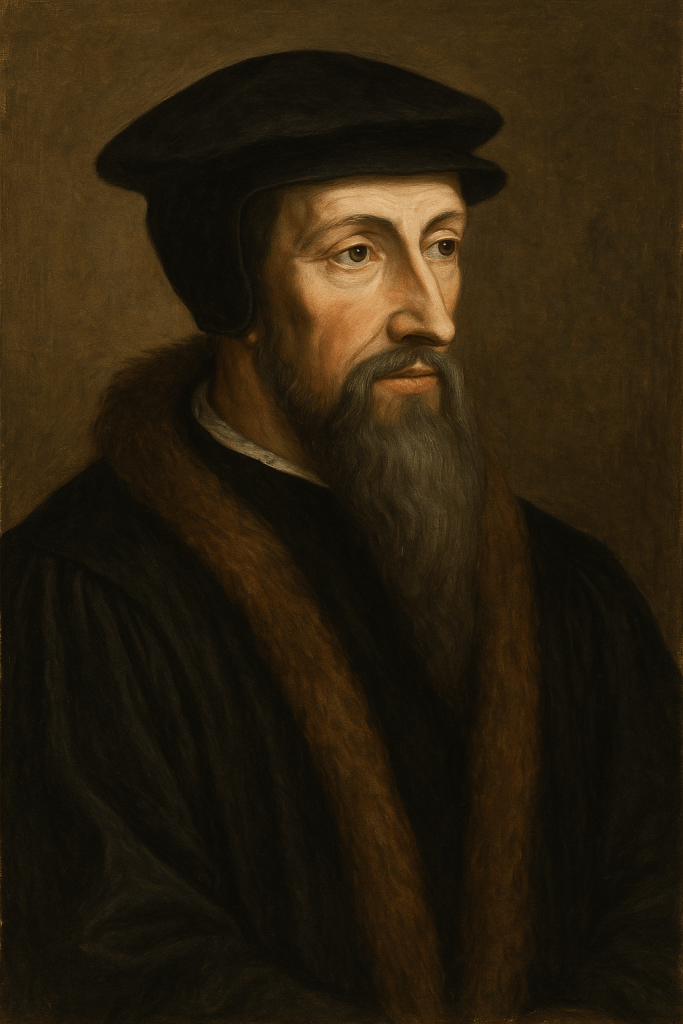
On July 10, 1509, in the small cathedral town of Noyon, France, a child was born who would grow to become one of the most influential theologians and church reformers in the history of Christianity—John Calvin. Though his life would be marked by exile, controversy, and sickness, Calvin’s relentless pursuit of God’s truth would shape not only the course of the Protestant Reformation, but also the worship, polity, and doctrine of countless churches around the world. On the anniversary of his birth, we do well to pause, not to glorify the man, but to give thanks to God for the ways He used a humble scholar from northern France to ignite theological clarity and spiritual renewal that still resonates centuries later.
Calvin’s theological system is best known through his magnum opus, The Institutes of the Christian Religion—a work that he first published at the age of 26 and continued to revise throughout his life until the definitive edition of 1559. But Calvin was more than a theologian; he was a pastor, a biblical commentator, and above all, a servant of Christ’s church. He insisted that theology must never be abstract but always devotional and practical: “True and sound wisdom consists of two parts: the knowledge of God and of ourselves” (Battles ed., Institutes, 1.1.1). This reciprocal knowledge—of who God is and who we are in relation to Him—forms the heartbeat of Calvin’s spiritual vision.
Even in the opening lines of the Institutes, Calvin displays a deep humility before the majesty of God. “Without knowledge of self,” he writes, “there is no knowledge of God” (Beveridge ed., Institutes, 1.1.1). Yet he is quick to reverse the mirror: “It is evident that man never attains to a true self-knowledge until he has previously contemplated the face of God, and come down after such contemplation to look into himself” (Beveridge ed., Institutes, 1.1.2). For Calvin, the knowledge of God is not a cold academic pursuit, but a furnace that refines and humbles. We behold the holiness of God, and then see how stained and needy we are in contrast.
Calvin’s theology is often misrepresented as dry, distant, and austere. Yet those who take time to read him will encounter someone deeply committed to the warmth of divine love and the assurance of God’s grace. Calvin writes, “Our being should not be under the dominion of ourselves, but we should live entirely to the Lord and die to him” (Battles ed., Institutes, 3.7.1). From this, the Christian life becomes not a rigid checklist of doctrine, but a responsive life of joyful obedience rooted in love for God.
His pastoral vision extended far beyond academic theology. Calvin spent his life building up the church in Geneva, despite multiple exiles, illnesses, and opposition. He preached sermons daily, taught students, visited the sick, and labored for the moral and spiritual renewal of the city. One of his most powerful legacies is not just what he taught, but how he lived under the Lordship of Christ. “We are not our own,” he writes, “therefore, let us live for him and die for him” (Beveridge ed., Institutes, 3.7.1).
And yet, Calvin’s own awareness of human weakness and divine sovereignty kept him grounded. He described the human heart as “a perpetual forge of idols” (Beveridge ed., Institutes, 1.11.8) and pointed readers constantly away from their own works to rest in the finished work of Christ. “Until men recognize that they owe everything to God,” he writes, “that they are nourished by his fatherly care, that he is the Author of their every good—until they humble themselves completely and strip themselves of all self-confidence—they will never give him his due” (Battles ed., Institutes, 1.1.1).
So, on this July 10th, we remember John Calvin not as a flawless man or a distant intellectual, but as a faithful servant of Christ who labored so that others might see the greatness of God. As he once prayed, “I offer my heart to you, O Lord, promptly and sincerely.” That motto—Cor meum tibi offero, Domine, prompte et sincere—still echoes today. May his life invite us to deeper reverence, humility, and faith in our sovereign and gracious God.
II. Calvin the Theologian: Institutes and a Vision of God’s Glory
If Martin Luther cracked open the door of the Reformation, John Calvin stepped through it and built a theological house to dwell in. His Institutes of the Christian Religion is not only the most influential Reformed work of systematic theology, but one of the most enduring and expansive theological texts in the history of the church. Written originally in 1536 and revised over two decades until its final form in 1559, the Institutes was Calvin’s attempt to give “a sum of piety” and a “doctrine that is necessary to know” (Battles ed., Prefatory Address). It was, in Calvin’s words, “a key to open a way for all children of God into a right and true understanding of Holy Scripture” (Beveridge ed., Prefatory Address).
From the first page to the last, Calvin’s theology revolves around one central aim: the glory of God in the salvation of sinners. The famous opening lines declare that “true and sound wisdom consists of two parts: the knowledge of God and of ourselves” (Battles ed., Institutes, 1.1.1). This twofold knowledge sets the framework for everything that follows. God is sovereign, holy, and utterly self-sufficient; man is fallen, needy, and dependent. Theology, then, is not an abstract science, but a practical discipline meant to drive the heart into awe, reverence, and trust.
Calvin’s emphasis on the sovereignty of God is one of the defining marks of his theology. This does not begin with the controversial doctrine of predestination, but with the very nature of God as Creator and Sustainer of all things. “Nothing is more absurd,” Calvin writes, “than that anything should be done without God’s ordination, because it happens against his will” (Beveridge ed., Institutes, 1.16.6). Providence is not a cold determinism, but the comforting assurance that not even a sparrow falls apart from the Father’s hand.
In matters of salvation, Calvin’s theological clarity is most vibrant. He saw man as spiritually dead apart from grace, incapable of seeking God or choosing righteousness on his own. “Original sin,” Calvin writes, “seems to be a hereditary depravity and corruption of our nature” which renders us “obnoxious to God’s wrath” (Battles ed., Institutes, 2.1.8). Yet it is in this helpless state that the mercy of God shines brightest. Election, for Calvin, is not a theological abstraction but a testimony of divine love: “God has adopted us once for all in order that we may persevere to the end” (Battles ed., Institutes, 3.21.7).
Calvin’s doctrine of union with Christ brings warmth and cohesion to his soteriology. Every saving benefit—justification, sanctification, adoption—is received in Christ and through the Spirit. “As long as Christ remains outside of us,” Calvin insists, “and we are separated from him, all that he has suffered and done for the salvation of the human race remains useless and of no value to us” (Battles ed., Institutes, 3.1.1). Faith is the Spirit-given bond that unites the believer to Christ, and this union is both legal (justification) and transformative (sanctification).
Far from promoting a dry orthodoxy, Calvin taught that true theology always issues in piety, which he defined as “that reverence joined with love of God which the knowledge of his benefits induces” (Battles ed., Institutes, 1.2.1). The goal of doctrine is not simply to inform but to ignite the heart. Theology is not merely for the scholar but for the worshiper. “It is evident,” Calvin writes, “that man never attains to a true self-knowledge until he has previously contemplated the face of God” (Beveridge ed., Institutes, 1.1.2). To know God rightly is to be changed by Him inwardly.
The scope of the Institutes is enormous—covering topics from Scripture’s authority, to the Trinity, to civil government—but it is always tethered to one central concern: that God be honored and glorified, and that sinners find refuge in Christ. Whether Calvin is describing the majesty of God’s law or the depths of the atonement, he writes with a pastor’s heart and a theologian’s mind. He leaves no room for self-confidence, but points again and again to the sufficiency of Christ and the majesty of grace.
In a world often intoxicated with autonomy and self-justification, Calvin’s vision remains radically God-centered. “Man is so blinded by pride,” he writes, “that he counts himself sufficient to obtain righteousness” (Beveridge ed., Institutes, 3.12.2). But Calvin knew better, and he called the church to look upward—to the sovereign God, to the crucified Christ, to the Spirit who gives life. That vision, born in the pages of the Institutes, still gives light to pilgrims who long to see the face of God.
III. Calvin’s Ecclesiology: A Church Reformed and Always Reforming
For John Calvin, the doctrine of the church was not an afterthought but a vital branch of Christian theology. He believed that God’s redemptive work in the world was not merely individual but corporate—centered in the visible body of Christ, the church militant on earth. As one who labored tirelessly for ecclesiastical reform in Geneva, Calvin saw the reformation of the church as the necessary outworking of the gospel’s renewal. The purified preaching of the Word and the right administration of the sacraments were, for him, not just ecclesial duties—they were marks of the true church.
Calvin famously defined the church in these terms:
“Wherever we see the word of God purely preached and heard, and the sacraments administered according to Christ’s institution, there, it is not to be doubted, a church of God exists.” (Battles ed., Institutes, 4.1.9)
This twofold standard—Word and sacrament—was Calvin’s measuring rod for authentic Christian community. He rejected both the spiritual individualism that severed Christians from the visible church and the corrupted institutionalism of the medieval church, which had obscured the gospel with superstition and abuse. In Geneva, he sought to restore the church to biblical fidelity, not by innovation, but by recovery—a return to apostolic simplicity and purity.
One of Calvin’s most significant contributions to ecclesiology was his reformation of church government. He taught that Christ alone is the Head of the church, and under Him are four offices established for its upbuilding: pastors, teachers (doctors), elders, and deacons. These roles were grounded in Scripture, particularly in Ephesians 4 and 1 Timothy 3. Calvin resisted any form of hierarchy that elevated one office above the rest—especially the monarchical papacy—calling it a “tyranny” inconsistent with the New Testament church.
“There is no other rule for the right government of the church than that which he [Christ] has laid down in his word.” (Beveridge ed., Institutes, 4.8.9)
The pastors were responsible for preaching and administering the sacraments; the teachers ensured doctrinal integrity; the elders oversaw the moral and spiritual conduct of the flock; and the deacons cared for the poor and needy. Calvin’s Geneva Consistory, made up of pastors and elders, exercised church discipline, not to tyrannize consciences, but to maintain the holiness of the church and shepherd straying sheep back to Christ.
Church discipline, in Calvin’s view, was not optional but essential. He wrote:
“As the saving doctrine of Christ is the soul of the church, so discipline forms the ligaments which connect the members together, and keep each in its proper place.” (Beveridge ed., Institutes, 4.12.1)
He understood discipline as both corrective and restorative—an expression of love, not legalism. A church that failed to practice discipline would, in Calvin’s mind, quickly become spiritually diseased and indistinguishable from the world. “Discipline,” he warned, “is like a bridle to restrain and tame those who rage against the doctrine of Christ” (Battles ed., Institutes, 4.12.1).
The Lord’s Supper, too, held a central place in Calvin’s ecclesiology. While rejecting Roman transubstantiation and Lutheran consubstantiation, Calvin taught that believers are truly nourished by the real spiritual presence of Christ through faith. The Supper is not a bare symbol, but a means of grace, binding the church together in union with Christ. As Calvin wrote:
“The sacred mystery of the Supper consists in the spiritual reality of that communion which we have with Christ in his flesh and blood, and with all his members.” (Battles ed., Institutes, 4.17.1)
For Calvin, the visible church was not perfect, but it was necessary. “The church is the mother of all believers,” he declared, “for there is no other way to enter into life unless she conceive us in her womb, give us birth, nourish us at her breast, and lastly…keep us under her care and guidance” (Battles ed., Institutes, 4.1.4). Though plagued with faults, the church remains God’s chosen instrument to proclaim the gospel, train disciples, and extend the kingdom.
This ecclesiological vision became foundational to Presbyterian polity and Reformed churches worldwide. Its genius was in balancing local authority with biblical accountability, structure with spiritual vitality. Calvin’s model aimed to recover not just doctrinal purity, but also pastoral care and community holiness—reforming the church according to the Word of God.
In our fragmented age, Calvin’s vision is a call to recover the high view of the church as Christ’s body, governed by His Word, sustained by His grace, and reformed continually by His Spirit. The ecclesia reformata semper reformanda—“the church reformed and always reforming”—is not a slogan of progressivism, but a commitment to ongoing repentance and fidelity to Scripture.
IV. Calvin and the Dutch Reformed Tradition
Though John Calvin never stepped foot in the Netherlands, his theological vision became the bedrock of Dutch Reformed Christianity for generations. His influence in the Low Countries was not merely intellectual—it was deeply ecclesiastical, political, and spiritual. Through his writings, students, and the spread of Reformed confessions, Calvin’s theology shaped the identity of a people who would become known for their commitment to doctrinal clarity, personal piety, and confessional fidelity.
The Dutch Reformation, like other Protestant movements, began as a response to the theological and moral corruption of the medieval church. But while Lutheranism made early inroads, it was Calvinism that ultimately captured the Dutch heart. What drew the Dutch to Calvin’s thought was not just his doctrine of predestination or his critique of Rome, but his robust vision of God’s sovereignty over every sphere of life—a vision particularly compelling in a nation struggling for religious and political freedom under Catholic Spain.
Calvin’s Geneva Academy played a pivotal role in training future Dutch ministers and theologians. Students such as Zacharias Ursinus, Caspar Olevianus, and Franciscus Junius carried Calvin’s theology back to the Netherlands, where they became instrumental in shaping the early Reformed churches. The Dutch quickly developed their own expressions of Calvinistic thought, culminating in the Three Forms of Unity: the Belgic Confession (1561), the Heidelberg Catechism (1563), and the Canons of Dort (1619). Each of these documents bears the clear imprint of Calvin’s theology—especially in its view of Scripture, the church, human depravity, and divine election.
The most defining moment of Calvin’s impact in the Netherlands came with the Synod of Dort (1618–1619). This international Reformed council was convened to respond to the rise of Arminianism, a movement that challenged Calvin’s teachings on grace and predestination. The Synod reaffirmed the doctrines Calvin championed, particularly unconditional election, limited atonement, and irresistible grace—forming what would later be remembered as the Five Points of Calvinism or TULIP.
Although Calvin never systematized his theology into five points, his Institutes contain the heart of these doctrines. Regarding election, he wrote:
“We say, then, that Scripture clearly proves this much, that God by his eternal and immutable counsel determined once for all those whom he would one day admit to salvation, and those whom he would condemn to destruction.” (Beveridge ed., Institutes, 3.21.7)
Calvin did not present election as a cold decree, but as a source of assurance and worship. He emphasized that election is rooted not in human worthiness but solely in God’s mercy and purpose:
“If we are elected in Christ, we shall find in him the assurance of our election.” (Battles ed., Institutes, 3.24.5)
The Dutch Reformed churches adopted this Christ-centered understanding of predestination, maintaining a strong sense of God’s covenant love and the believer’s security in Christ.
Calvin’s influence also extended to church polity and liturgy in the Netherlands. Dutch Reformed churches followed a Presbyterian model of governance, with ministers and elders sharing responsibility in consistories. Worship services centered on preaching, prayer, psalm singing, and the sacraments—echoing Calvin’s desire for simplicity and biblical faithfulness. “God disapproves all modes of worship not expressly sanctioned by his Word,” Calvin warned (Beveridge ed., Institutes, 4.10.23). The Dutch heeded that warning, developing a liturgy that was reverent, didactic, and saturated with Scripture.
Calvin’s understanding of the Christian life also resonated with the Dutch. His call to live “coram Deo”—before the face of God—was not confined to the church pew but extended into the home, the marketplace, and the government. This worldview would later give rise to a distinctively Reformed cultural vision championed by Dutch theologians like Abraham Kuyper, who famously declared, “There is not a square inch in the whole domain of our human existence over which Christ, who is Sovereign over all, does not cry, ‘Mine!’”
In Calvin’s words:
“The Lord bids each one of us in all life’s actions to look to his calling. For he knows with what great unrest the human mind is borne hither and thither… So that no one may thoughtlessly transgress his limits, he has named these various kinds of living ‘callings.’” (Battles ed., Institutes, 3.10.6)
This doctrine of vocation—rooted in Calvin’s theology—took deep root in the Netherlands, producing generations of believers committed to faithfulness in both church and society.
Today, Dutch Reformed theology continues to shape churches across the world, from the Netherlands to South Africa, from Canada to the United States. While the landscape of Reformed churches has diversified, the DNA of Calvin’s Geneva remains unmistakable. His vision for a church under the Word, a life lived before God, and a kingdom extending into every area of life continues to animate and guide faithful believers across the centuries.
V. Calvin’s Spiritual Legacy Among the English Puritans and Scottish Presbyterians
Though John Calvin’s ministry was rooted in Geneva, his influence surged beyond the borders of continental Europe—especially into England, Scotland, and eventually America. The English Puritans and the Scottish Presbyterians adopted and adapted Calvin’s theology, shaping movements that would impact the course of Christian history for centuries. In them, Calvin found not only eager readers but spiritual heirs—men and women who embraced his theology of God’s sovereignty, covenantal worship, and a life lived under the lordship of Christ.
Calvin’s relationship to the English Reformation was both direct and providential. During the reign of Mary I (“Bloody Mary”), many English Protestants fled persecution and found refuge in Geneva. These Marian exiles—including John Knox and others—were exposed firsthand to Calvin’s ecclesiastical reforms and theological writings. When they returned to England under Elizabeth I, they brought with them not just ideas, but a vision: a purified church governed by the Word of God alone.
The Puritans, as they came to be known, were not a monolith but a movement marked by zeal for biblical fidelity. They longed to see the Church of England further reformed in worship, doctrine, and discipline. Calvin’s Institutes provided them with a comprehensive theological framework rooted in Scripture and aimed at producing a godly people. His doctrine of total depravity, effectual calling, and covenantal obedience were all embraced and preached from English pulpits. One Puritan minister declared that the Institutes was the “greatest work written since the days of the apostles.”
Calvin’s understanding of the Christian life as one of ongoing repentance and sanctification resonated with Puritan spirituality. He wrote:
“The whole life of Christians ought to be a sort of practice of godliness.” (Beveridge ed., Institutes, 3.6.5)
The Puritans adopted this ethos wholeheartedly, emphasizing family worship, Sabbath observance, self-examination, and spiritual disciplines—not as legalism, but as the outworking of a regenerate heart. The Puritan mind, while scholastic in training, was deeply pastoral. They sought what Calvin called the experientia of grace—the lived experience of Christ’s sanctifying work through Word and Spirit.
In Scotland, Calvin’s legacy was most visibly realized through John Knox, a fiery reformer who spent time in Geneva under Calvin’s tutelage. Knox called Geneva “the most perfect school of Christ that ever was on the earth since the days of the apostles.” Upon returning to Scotland, Knox helped establish a national church modeled closely after Calvin’s vision: eldership rule, simple liturgy, expository preaching, and a high view of God’s sovereign grace.
This gave birth to Scottish Presbyterianism, which enshrined many of Calvin’s principles into enduring institutional forms. The First Book of Discipline (1560) and the Second Book of Discipline (1578) reflected Calvin’s influence in church polity and doctrine. But perhaps the fullest flowering came in the Westminster Assembly (1643–1653), where English and Scottish theologians crafted the Westminster Confession of Faith—a document deeply Calvinistic in tone and structure.
Calvin’s theology of God’s sovereign grace was at the heart of Westminster’s statements on predestination, justification, sanctification, and perseverance. The Assembly echoed his understanding that salvation is entirely by divine mercy:
“As Scripture, when it speaks of our free election, removes all merit on our part, so it enjoins humility, and deprives man of all pretext for glorying.” (Battles ed., Institutes, 3.21.2)
The English Puritans and Scottish Presbyterians did not worship Calvin. But they saw in him a guide—a shepherd-theologian who had faithfully taught the Word of God and called the church to holiness. They passed his theology on to future generations, including the American Puritans, who planted Calvinistic doctrine deep into the soil of New England. Preachers like Jonathan Edwards carried the torch forward, preaching the majesty of God and the weight of eternal things with Calvin’s deep sense of reverence.
Even today, Calvin’s fingerprints are visible in Reformed confessions, Presbyterian polity, and Reformed seminaries across the world. Wherever Christ is preached with awe, and the Scriptures are held in highest esteem, Calvin’s legacy quietly endures. As he wrote near the end of his Institutes:
“Let us not cease to do the utmost, that we may incessantly go forward in the way of the Lord… until we shall at length arrive at the goal.” (Beveridge ed., Institutes, 3.6.5)
Calvin never desired to be known as a reformer, but as a humble servant of the Word. And in the Puritans and Presbyterians, we see the fruit of that humble obedience—a church reformed by the Scriptures and aflame with a passion for the glory of God.
VI. Calvin’s Broader Cultural and Ecumenical Impact
John Calvin is best known as a theologian of grace and a reformer of the church, but his impact reaches far beyond the pulpit or the seminary. His influence has permeated realms as varied as education, politics, economic theory, and global Christianity. He was a man of the Word, to be sure—but his vision of God’s sovereignty over all of life made him a forerunner of what we now call a Christian worldview. Calvin believed that all creation belongs to God, and that every domain of human endeavor must come under Christ’s lordship. In this way, his legacy is not only ecclesial but cultural—and not only Reformed but ecumenical.
Calvin’s doctrine of providence undergirded his view of the world as an ordered, purposeful creation governed by God’s sovereign hand. He wrote:
“The Lord has so knit together the order of the world, that nothing can be done without his will or permission.” (Beveridge ed., Institutes, 1.16.6)
Far from promoting fatalism, this conviction gave Calvin confidence that every part of life—science, labor, law, and art—had meaning under the reign of Christ. This notion would later fuel Protestant work ethic theories, particularly in sociologist Max Weber’s famous thesis that Calvinism contributed to the rise of capitalism by dignifying secular work as a calling (Beruf).
But Calvin was not an economist; he was a pastor and theologian who saw all of life as “coram Deo”—before the face of God. In this light, work, study, and civic duty were all to be performed with reverence and responsibility. He declared:
“The Lord bids each one of us in all life’s actions to look to his calling… so that no one may thoughtlessly transgress his limits.” (Battles ed., Institutes, 3.10.6)
This doctrine of vocation elevated the ordinary. Calvin taught that the farmer behind his plow and the magistrate behind his desk both served Christ as meaningfully as the preacher in his pulpit, provided they acted in faith and obedience.
Calvin also placed a strong emphasis on education, founding the Geneva Academy in 1559 to train both ministers and lay leaders in the Word of God. Literacy was central, since the people of God needed to read Scripture for themselves. This emphasis helped usher in a culture of learning and critical thinking across Protestant Europe. In time, Reformed schools, universities, and seminaries were established throughout the world—from Princeton and Yale in America to Stellenbosch in South Africa.
In terms of politics, Calvin’s legacy is complex but significant. He was not a champion of popular sovereignty, but his insistence that all human authority is derived from God and accountable to Him laid the theological groundwork for resistance to tyranny and the rise of constitutional governance. Calvin insisted:
“We are subject to the men who rule over us, but only in the Lord; if they command anything against Him, let us not pay the least regard to it.” (Beveridge ed., Institutes, 4.20.32)
This principle—known as the doctrine of lesser magistrates—was later employed by Reformed resistance movements across Europe and helped influence early American political thought, particularly among Calvinist dissenters.
Perhaps most surprisingly, Calvin’s influence reaches into ecumenical Christianity as well. Though his theology was distinctively Reformed, his emphasis on Scripture, grace, and the majesty of God has resonated with Christians from diverse traditions. In the 20th and 21st centuries, Calvin has been read not only by Presbyterians and Dutch Reformed churches, but by Baptists, Anglicans, Methodists, and even Roman Catholics. The rise of evangelical Calvinism in recent decades—seen in the ministries of figures like J.I. Packer, R.C. Sproul, and John Piper—demonstrates that Calvin’s voice still speaks powerfully to a global audience hungry for doctrinal depth and spiritual integrity.
Moreover, many Reformed churches in the Global South—particularly in Africa, Asia, and Latin America—trace their theological lineage to Calvin, either through missionary influence or indigenous adoption. These churches are now among the fastest-growing segments of the global church. In 2010, more than 80 million believers belonged to the World Communion of Reformed Churches, a testimony to Calvin’s global reach.
And yet, Calvin himself would be the last to seek credit. He labored not to exalt his name, but to exalt the name of Christ. As he wrote:
“We should consider that the principal end of our lives is to be so reconciled to God, and to devote ourselves wholly to him, that his glory may shine forth in us.” (Beveridge ed., Institutes, 3.6.6)
In every generation, Calvin calls the church back to God-centered worship, grace-filled theology, and lives lived for the glory of Christ in every sphere. That is why, even five centuries later, his vision continues to inspire and shape the global church—ever reformed, ever reforming.
VII. Why We Still Need John Calvin
In an age defined by theological confusion, spiritual consumerism, and institutional instability, the life and legacy of John Calvin remain remarkably relevant. Born over five hundred years ago, Calvin was not interested in novelty, popularity, or building a personal brand. He was captivated by the majesty of God, the authority of Scripture, and the glory of Christ in the church. And he labored—quietly, often painfully—for the rest of his life so that the truth of God might reign in the hearts of His people. Today, we still need John Calvin—not because he was perfect, but because he was faithful.
Calvin reminds us that theology is not a mere intellectual exercise but a matter of life and death. He begins his Institutes by showing that true wisdom begins with knowing God and knowing oneself rightly:
“Our wisdom, in so far as it ought to be deemed true and solid wisdom, consists almost entirely of two parts: the knowledge of God and of ourselves.” (Battles ed., Institutes, 1.1.1)
In an age obsessed with self-expression and self-fulfillment, Calvin redirects our gaze upward. We are not autonomous individuals floating in a meaningless cosmos; we are creatures made by a holy God, corrupted by sin, and in need of redemption. The recovery of this twofold knowledge—of God’s majesty and man’s misery—is as vital today as it was in Calvin’s time.
Calvin also reminds us that the church matters. In a world where church attendance is declining and institutional distrust is on the rise, Calvin’s robust vision of the visible church stands as a countercultural testimony. The church, he insists, is the mother of believers, the household of faith, and the place where God nourishes His people:
“There is no other way to enter into life unless she [the church] conceive us in her womb, give us birth, nourish us at her breast, and lastly…keep us under her care and guidance.” (Battles ed., Institutes, 4.1.4)
His commitment to preaching, sacraments, discipline, and godly leadership is not about control but care—about forming a people devoted to God and conformed to Christ.
Perhaps most importantly, Calvin reminds us of the supremacy of God’s grace. In his view, salvation is not the result of our striving or achievements but the free mercy of a sovereign God. This was not cold fatalism—it was the burning center of Christian assurance and joy. “We are elected in Christ,” Calvin wrote, “and we shall find in him the assurance of our election” (Battles ed., Institutes, 3.24.5). Far from producing arrogance, this truth should lead to humility and worship. As Calvin put it:
“Let us not be ashamed to be ignorant in something, or not to succeed in everything. Let us be content to be learners in Christ’s school until the end.” (Beveridge ed., Institutes, Prefatory Address)
This is why Calvin’s legacy lives on. He did not set out to build a movement; he sought only to be faithful to the Word of God. Yet his vision reshaped nations, emboldened reformers, instructed generations of believers, and gave the church a theological foundation that still stands today.
Calvin’s personal motto, which he used in correspondence and had engraved in his heart, was this:
“Cor meum tibi offero, Domine, prompte et sincere”—“I offer my heart to you, O Lord, promptly and sincerely.”
That is a fitting summary of his life. Not self-centered ambition, but joyful surrender. Not innovation for its own sake, but faithfulness to God’s Word. Calvin’s enduring relevance is found not in the age of his books, but in the timelessness of the truth he taught. And though he is often caricatured as austere or severe, those who read him with care will discover a man full of pastoral tenderness and spiritual insight.
So on this July 10th, let us remember John Calvin not as a distant relic of the past, but as a gift of Christ to His church. Let his words reawaken our awe of God. Let his vision rekindle our love for Scripture. Let his example encourage us to live sincerely, courageously, and reverently—before the face of God, in the power of His grace, and for the glory of His name.
“For since we are not our own, in so far as we can, let us forget ourselves and all that is ours.” —John Calvin (Beveridge ed., Institutes, 3.7.1)
On July 8th, 1741, Jonathan Edwards delivered what would become the most famous sermon in American history—Sinners in the Hands of an Angry God. It has been memorialized in textbooks as a quintessential fire-and-brimstone message, one of terror and trembling. But what’s often overlooked is why Edwards felt compelled to preach such a piercing word of warning.
This sermon was not merely about evoking fear. It was a desperate plea from a pastor who had inherited a congregation steeped in false assurance. That assurance had a name and a history—it began with Edwards’ own grandfather, Solomon Stoddard. Stoddard was a towering figure in New England’s religious life, and one of his most controversial legacies was the promotion of what might be called “communion table conversion.” He taught that the Lord’s Supper was not only a means of grace for the converted, but a tool to awaken faith in the unconverted. For Stoddard, the table was open to all, even those who gave no evidence of regeneration.
This theological experiment planted seeds of spiritual complacency. Instead of preaching repentance and the new birth, many ministers under Stoddard’s influence extended the sacraments to unrepentant hearts. Church membership and table fellowship became cultural inheritances, not covenantal realities. In short, people were told they belonged to Christ without being born again.
Jonathan Edwards would not have it.
When Edwards stepped into the pulpit on that hot July day, he did so to awaken a people lulled to sleep by ritual and sentimentality. Sinners in the Hands of an Angry God was not a random burst of Puritan wrath—it was a surgical strike against generations of theological compromise. It was a call to true conversion, to flee from the wrath to come and lay hold of Christ by faith—not by presumption.
In this post, I want to trace the roots of this problem, expose its modern equivalents, and renew the call to guard the Lord’s Table with reverence, as Scripture commands.
II. The Stoddardian Legacy: A Faulty Foundation
To understand the urgency and weight of Jonathan Edwards’ ministry, we must look backward—not just to Scripture, but to the spiritual inheritance he received from his grandfather, Solomon Stoddard. Stoddard served as pastor of Northampton’s Congregational Church for over 60 years and was one of the most influential religious figures in colonial New England. His towering presence shaped not only the ecclesiology of his local congregation, but also the theological climate of the region.
But beneath his reputation for revivalism lay a troubling innovation: the opening of the Lord’s Supper to the unconverted. Stoddard taught that the sacraments could function as “converting ordinances”—that participation in communion could lead to, or even result in, a person’s saving faith. This marked a significant departure from the historic Reformed understanding, which reserved the table for those who had already professed faith and shown signs of regeneration.
What followed was a widening of the church’s gates without a corresponding call to the narrow path of repentance and faith. Baptized individuals, many without any credible testimony of conversion, were encouraged to partake of the Supper. Stoddard himself claimed to have been converted at the communion table—an experience that gave theological legitimacy to his practice. But this personal testimony, however sincere, was elevated to ecclesial policy, creating generations of churchgoers who confused sacramental participation with saving grace.
The result was tragic: a church culture where many presumed they were safe simply because they were present. Assurance of salvation was no longer tethered to the inward work of the Spirit, but to outward observance. The Lord’s Table, intended as a memorial for the redeemed, had become an altar for the unregenerate.
By the time Jonathan Edwards assumed leadership of the Northampton church, he found himself preaching to a congregation largely inoculated against the gospel by Stoddard’s innovations. The spiritual complacency he faced was not accidental—it was inherited. And Edwards, with pastoral courage and deep reverence for the holiness of God, saw that revival would not come without first dismantling the very system his grandfather had built.
III. Edwards’ Inheritance: A Congregation Needing Awakening
When Jonathan Edwards stepped into pastoral leadership at Northampton in 1729, he was not merely filling the pulpit of his grandfather—he was inheriting a deeply ingrained theological system that blurred the lines between the church and the world. His people were respectable, religious, and devout in appearance. But behind their churchgoing rhythm was a dangerous spiritual slumber, born from years of false assurance rooted in routine sacramentalism.
Edwards did not step into that pulpit as a revolutionary firebrand. In fact, his early years were marked by careful, thoughtful preaching focused on God’s holiness, man’s sinfulness, and the necessity of the new birth. But over time, it became clear that the sheepfold he tended was filled with many who had never been truly born again. They had been catechized, baptized, and brought to the table—many since childhood—but without any evidence of regeneration. Edwards recognized that their greatest danger was not outright rebellion, but unexamined presumption.
This conviction came to a head on July 8, 1741, when Edwards delivered Sinners in the Hands of an Angry God in Enfield, Connecticut—though its thunderclap echoed in Northampton. The sermon wasn’t random fire-and-brimstone rhetoric; it was the spiritual defibrillator his people needed. With vivid imagery and biblical gravity, Edwards portrayed the precariousness of life apart from Christ: sinners dangling by a thread over the fires of God’s righteous judgment.
But what made this sermon so controversial—then and now—was its audience. Edwards wasn’t preaching to pagans; he was preaching to covenant children, pew-sitters, moralists, and table-partakers. He saw that many of them were relying on outward signs rather than inward renewal. He was calling them to examine themselves—not merely for formality’s sake, but for their souls’ salvation.
His pastoral task was not to uphold tradition but to expose the error within it. Edwards loved his people enough to trouble their consciences. He longed for them to exchange empty ritual for authentic repentance. In confronting the spiritual lethargy of his congregation, he was not undermining his grandfather’s legacy to be spiteful—he was attempting to restore biblical fidelity where sentimental theology had taken root.
Revival, in Edwards’ view, would never come by softening the truth. It would come only when sinners awoke to their true condition and fled to Christ—not a cup of wine—for mercy.
IV. The Half-Way Covenant and Its Modern Descendants
To fully grasp the danger Jonathan Edwards confronted, one must consider the theological soil from which it grew: the Half-Way Covenant. Introduced in 1662, this compromise was born of pastoral anxiety. As fewer second-generation Puritans professed saving faith, ministers faced a dilemma—either withhold the sacraments from an increasing number of baptized children, or redefine what church membership meant.
Many chose the latter.
The Half-Way Covenant permitted baptized, yet unconverted, individuals to become partial church members and have their own children baptized. It was a theological concession that slowly decayed the holiness of the church. What began as an attempt to retain cultural unity became a breeding ground for nominalism. Baptism became a badge of citizenship, not of regeneration. And over time, the Lord’s Supper—originally reserved for the regenerate—was increasingly opened to all who outwardly conformed.
Solomon Stoddard took this a step further, arguing that the Lord’s Table could be a converting ordinance, and that excluding “morally upright” unbelievers from it was unjust. His rationale was built more on pragmatism and personal experience than on Scripture. His famous claim of being converted at the communion table set the precedent for inviting others to seek the same—and it provided theological cover for widening the gate even further.
This same logic finds new life in certain modern practices, particularly among advocates of paedocommunion—the idea that young, unexamined children of believers should partake in the Lord’s Supper based solely on their covenant status. One prominent voice in this movement is Douglas Wilson, who has publicly defended the practice within the broader framework of “covenantal objectivity.” While Wilson and others may not explicitly cite Stoddard, their conclusions align: access to the table is based on association, not necessarily on regeneration.
But Scripture does not allow this. Paul’s warning in 1 Corinthians 11 makes it clear: “Let a person examine himself, then, and so eat of the bread and drink of the cup” (v. 28). The requirement for self-examination presumes self-awareness, discernment, and faith—things that are not present in the unconverted or the undeveloped conscience of a young child.
Just as the Half-Way Covenant attempted to preserve religious heritage at the cost of doctrinal clarity, so too do modern revisions of the Supper obscure the line between the church and the world. But God’s ordinances are not to be reinvented in the name of inclusion. They are to be guarded with fear, reverence, and obedience to His Word.
V. The Biblical Witness: The Lord’s Supper as Covenant Renewal for the Regenerate
God has not left us without instruction concerning who may partake in the Lord’s Supper. The Apostle Paul, writing under the inspiration of the Holy Spirit, addresses this explicitly in 1 Corinthians 11. Far from being a casual ritual or sentimental gesture, the Lord’s Table is a holy ordinance—a moment of covenant renewal between Christ and His redeemed people. It is not a tool for evangelism. It is not a rite of passage. It is not an invitation to the curious or the carnal.
“Let a person examine himself, then, and so eat of the bread and drink of the cup. For anyone who eats and drinks without discerning the body eats and drinks judgment on himself.” (1 Cor. 11:28–29, ESV)
These are sobering words. Paul warns that to come to the table without examination, without spiritual discernment, is to invite God’s judgment—not His grace. The Supper does not convert; it confirms. It does not save; it seals what is already true of the believer’s union with Christ. In this way, the Supper serves as a visible gospel for the regenerate—a means of strengthening faith, not initiating it.
To invite the unregenerate, the unrepentant, or the unexamined to the table is to profane the very blood it represents. The church is not authorized to distribute the body and blood of Christ to those who remain at enmity with Him. No parent can presume their child’s salvation and feed them Christ as if the elements are magic. No elder or pastor can neglect the biblical warning out of fear of being “unwelcoming.” Christ Himself is the one who fences the table—with the words of Scripture.
The Lord’s Supper is a covenant meal—echoing the covenant meals of the Old Testament, where only those in right standing with God could come. To eat at God’s table is to declare communion with Him. And communion requires union. Therefore, the Table is for the regenerate—those who have been born again, who are trusting in Christ alone for salvation, and who are walking in repentance and faith.
Any other practice turns the Supper into a lie, offering peace where there is no peace and strengthening false assurance rather than true hope.
VI. False Assurance and the Danger of Sentimental Sacramentalism
False assurance is perhaps the most terrifying spiritual condition one can possess: to believe one is at peace with God while remaining under His wrath. And no doctrine has contributed more to this condition than sentimental sacramentalism—the idea that participation in religious ordinances automatically conveys grace or secures standing before God.
This error, deeply embedded in Solomon Stoddard’s theology and perpetuated today in various forms, turns the holy ordinances of God into spiritual trinkets. When the Lord’s Supper is treated as an evangelistic tool or a family tradition rather than a covenantal affirmation of faith, it communicates a lie: that you can commune with Christ without being united to Him. That grace is dispensed without repentance. That covenant inclusion is inherited by bloodline rather than confirmed by the Spirit.
This is precisely what Paul condemned in 1 Corinthians 11. The Corinthian church was treating the Supper lightly—some with drunkenness, others with division, all without the required self-examination. And Paul does not rebuke them gently. He warns that those who eat and drink “without discerning the body” are bringing judgment upon themselves (v. 29). Some, he says, have grown weak and sick, and some have even died as a result (v. 30). God takes His ordinances seriously—even when His people do not.
Yet modern ministers—whether intentionally or not—continue the legacy of error when they extend the Table to the unregenerate. Some do it by encouraging children to partake simply because they’ve been baptized. Others do it by removing church discipline and opening the Table to anyone who “feels welcome.” In both cases, sentimentality replaces Scripture. The desire to be inclusive overrides the command to be holy.
But the Table is not a place of indiscriminate grace; it is a place of covenant renewal for those whose hearts have been circumcised by the Spirit. To invite the unconverted is to reinforce their delusion. To hand them the bread and cup without urging them to examine themselves is to lead them into a deeper spiritual fog.
Edwards saw this clearly. He knew that no tradition, no rite, no family connection could replace the miracle of regeneration. That is why he preached as he did—not to be harsh, but to be honest. The souls of his people were too precious to comfort with a lie.
We would do well to recover that same clarity today.
VII. A Call for Ministerial Courage and Biblical Fidelity
Jonathan Edwards was not driven by arrogance or theological novelty when he resisted his grandfather’s legacy—he was driven by a trembling fear of God and a burning love for the souls entrusted to him. In a time when spiritual formalism reigned, Edwards stood as a herald of truth, willing to sever tradition for the sake of fidelity. His refusal to permit unconverted individuals to the Lord’s Table, especially children and cultural Christians, eventually cost him his pulpit. Yet it secured something far greater: a testimony of ministerial integrity that still convicts and instructs the church today.
We need that same courage now.
Too many pastors, in an attempt to be palatable or “pastoral,” have lost sight of the sacred responsibility entrusted to them. Instead of guarding the Lord’s Table as a place of reverent renewal, they treat it like a family potluck where the only requirement is a seat at the table. But Scripture calls ministers to be shepherds, not hosts—protectors of Christ’s sheepfold, not appeasers of religious tradition.
Biblical fidelity often demands conflict with cherished customs, even those established by beloved predecessors. Edwards loved his grandfather, but he loved Christ more. He respected Stoddard, but he revered Scripture more. His ministry was marked by a willingness to offend man if it meant honoring God.
Today, ministers must resolve to do the same. We must preach the new birth—not as a suggestion, but as a necessity. We must guard the ordinances—not out of fear of man, but out of fear of the Lord. And we must be willing to say no—to parents, elders, and even denominational pressures—if the alternative is violating God’s Word.
The church is not preserved by sentiment, but by Scripture. And the Lord’s Table, rightly guarded, becomes a powerful means of grace for the believer—and a sober warning to the unrepentant.
Let us, then, follow in Edwards’ steps. Not by mimicking his eloquence or intensity, but by sharing his unwavering commitment to truth. May we preach repentance, guard the ordinances, and love our flocks enough to fence the Table with the gate God Himself has set in place: the new birth.
VIII. Conclusion: A Table Worth Guarding
July 8th should not merely be remembered for the emotional impact of Sinners in the Hands of an Angry God. It should be remembered as the day Jonathan Edwards fired a pastoral cannonball through the inherited assumptions of his age. He stood beneath the weight of a compromised legacy—his own grandfather’s legacy—and chose faithfulness to Christ over familial sentiment or cultural pressure. That choice cost him his ministry at Northampton, but it preserved the witness of the gospel for generations to come.
At the heart of Edwards’ ministry was a relentless desire to see true conversions, not manufactured ones. He understood that religious activity could lull people into a deadly sense of security, and that few errors were more destructive than offering spiritual assurance to those who had never truly repented. The communion table, for him, was not a means of evangelism—it was a place for the regenerate to remember Christ’s death, renew their covenant, and examine their hearts before God.
Today, the church faces similar temptations. We live in a time where doctrinal boundaries are often softened in the name of inclusion, and where sentimentality masquerades as compassion. But if we truly love our people—our children, our congregations, our communities—we will not offer them a false peace. We will not hand them the cup of the covenant without first calling them to the cross of Christ.
The legacy of Sinners in the Hands of an Angry God is not its rhetoric, but its resolve. It reminds us that revival begins with truth. That love tells the hard truths. That the ordinances of God are not ours to reinvent—but His to be obeyed.
We honor Edwards—not by admiring his boldness—but by following his example: guarding the Table, preaching the necessity of the new birth, and trusting that God uses faithfulness—not popularity—to build His church.
In an age of compromise, may we be known not as innovators, but as stewards. May we feed the flock, not flatter them. And may the Table of the Lord be once again seen for what it is: a holy meal for a holy people, bought with the holy blood of Christ.
In a world where relationships are increasingly defined by convenience and personal benefit, the idea of finding a truly loyal woman can feel like looking for a pearl in the depths of the sea. But the Word of God gives us enduring hope and guidance. One of the clearest pictures of loyalty in a godly woman is found in the biblical account of Ruth. Her story is not merely a romantic tale—it is a living testimony to the kind of covenantal, steadfast love that reflects the very heart of God.
As a man seeking a future wife who exemplifies Christlike loyalty, I am drawn to Ruth’s life as a model. Ruth was loyal to her deceased husband’s family, to her mother-in-law Naomi, and ultimately to her future husband Boaz. In every phase of her story, we see her embody the qualities of a faithful, trustworthy, and godly woman—qualities that I long to find in my own future wife.
Let’s walk through Ruth’s loyalty and see how she stood in contrast to modern red flags, and how she models what godly loyalty looks like in action.
Ruth Was Loyal to Her Husband Even in Death
Ruth’s story begins with tragedy. Her husband had died, and with him, the apparent security of her future. According to worldly wisdom, Ruth should have returned to her family, remarried in Moab, and moved on. But she didn’t. Instead, she honored her late husband by staying with Naomi, his mother, who was now a destitute widow.
This shows us something crucial: Ruth’s loyalty wasn’t based on what she could get. It was covenantal, not contractual. She did not abandon her commitment when it became inconvenient.
Red Flag Avoided: Quick to run when things are hard or when conflict arises.
Ruth stayed.
She clung to Naomi and the God of Israel with the famous words: “Where you go, I will go; where you stay, I will stay. Your people will be my people, and your God my God” (Ruth 1:16).
This is loyalty in its purest form—one that does not forsake when loss or hardship arises. That’s the kind of loyalty I desire to find in a woman: one who sees love as a covenant, even when life takes an unexpected turn.
Ruth Was Loyal to Naomi – Her Mother-in-Law
Ruth didn’t just stay with Naomi; she actively served and cared for her. She moved to a foreign land with no promise of protection, income, or status—simply because she loved and honored her family. Ruth worked in the fields to provide food for Naomi and did so without complaint or entitlement.
Red Flag Avoided: Withholding emotional support or affection when it’s inconvenient.
Ruth went out to glean in the fields not for her own benefit but for the well-being of her aging and bitter mother-in-law. When Naomi sank into despair, Ruth remained a steady presence—not preaching, not correcting, just faithful.
That kind of loyalty reveals a woman who has emotional resilience, compassion, and strength—all rooted in her commitment to others.
Ruth Was Loyal to Boaz Before They Were Married
What’s most stunning is that Ruth honored Boaz before there was any promise of marriage. When she approached him on the threshing floor (a culturally appropriate sign of interest in that day), she did so with humility, purity, and intention. There was no manipulation, no game-playing. She wasn’t chasing attention from other men.
Red Flag Avoided: Flirting or keeping close relationships with other men in secret.
Red Flag Avoided: Playing games or keeping options open.
Ruth’s actions reflected a woman who walked with integrity even when no one was watching. She guarded her reputation and maintained boundaries. She trusted God’s timing and honored Boaz as a man of worth.
That kind of woman is rare. She does not see relationships as a ladder to climb or a marketplace to sample. She sees marriage as a sacred union to be entered with prayer, patience, and discernment.
Ruth Spoke Honorably and Acted With Integrity
In every conversation recorded in the book of Ruth, she speaks with humility, honor, and grace. She listens well. She does not gossip, and she does not demean others to lift herself up. When she speaks to Naomi, the field workers, and Boaz, she is respectful and dignified.
Red Flag Avoided: Speaking critically of you to others without attempting resolution.
Ruth would not have been one to vent her frustrations on social media or tear down others with sarcasm. She dealt with life’s challenges with wisdom and grace, and she always upheld the dignity of the people around her.
What Loyalty Looks Like in a Godly Woman – Embodied by Ruth
Let’s revisit the traits of a loyal woman through the lens of Ruth:
1. Faithful to God First
Ruth turned from the gods of Moab and followed the Lord of Israel. Her loyalty to Naomi was ultimately rooted in her submission to God. She began every relationship by anchoring herself to the Lord.
2. Faithful to Her Future Husband
Before the wedding vows were ever exchanged, Ruth demonstrated the qualities of a faithful wife. She guarded her heart, protected Boaz’s integrity, and acted in accordance with righteousness.
3. Defends the Relationship
When others left, Ruth stayed. When Naomi was bitter, Ruth loved. When there was no clear path forward, Ruth walked in faith. She was not passive about her commitments.
4. Integrity When Alone
What Ruth did in the shadows of gleaning fields and in quiet conversations was consistent with what she did in public. She lived a life of transparency and integrity.
5. She Builds, Not Undermines
Ruth’s presence in Naomi’s life restored hope. Her union with Boaz brought redemption. She is not a woman who tears down—she builds legacy.
The Kind of Woman I’m Waiting For
As a man preparing my heart for marriage, I’m not looking for perfection. I’m looking for Ruth-like loyalty:
A woman who fears God above all
A woman who does not run from difficulty
A woman who guards her heart and speech
A woman who honors covenant over convenience
A woman who is consistent, faithful, and kind
I don’t need someone to perform. I need someone who will be faithful in the field when no one’s watching. Who will love when it’s hard. Who will stay when others leave.
I am praying that God is preparing a Ruth-hearted woman even now—one whose loyalty is not just romantic, but spiritual, moral, and enduring.
And I am preparing myself to be a Boaz—worthy of such a woman.
So to the young men reading: Look for loyalty not in public displays but in private decisions. And to the young women: Let Ruth be your model, not the influencers of the age.
God is still writing love stories that are built to last—and they begin with loyalty.
“May the Lord reward your work, and your wages be full from the Lord, the God of Israel, under whose wings you have come to take refuge.” — Ruth 2:12
William Perkins (1558–1602), known as the Father of the Puritan Movement, was a theologian and preacher who shaped generations of English Protestants. With clarity and pastoral urgency, Perkins laid out ten steps that describe the soul’s journey into true conversion. These were not intended as cold doctrines but as spiritual markers to help ordinary believers examine their hearts.
As Jesus said in Matthew 7:21, “Not everyone who says to me, ‘Lord, Lord,’ will enter the kingdom of heaven…” Genuine salvation is not merely a profession but a Spirit-wrought transformation.
Here are Perkins’ ten steps, explained, supported with Scripture, and expounded upon for today’s reader:
Hearing the Word of God with Conviction
“So faith comes from hearing, and hearing through the word of Christ.” —Romans 10:17
True conversion begins when the Word of God is heard—not only with the ears but with the conscience awakened. The Word pierces the heart and lays bare the soul. Regular engagement with Scripture uncovers sin, corrects the mind, and begins the inward work of grace.
Exegesis: Paul teaches that faith is not self-generated; it arises through the Spirit’s work as we encounter Christ in the gospel. Conviction is evidence that the Word is taking root.
Learning to Discern Good from Evil
“But solid food is for the mature, for those who have their powers of discernment trained by constant practice to distinguish good from evil.” —Hebrews 5:14
As a person continues in the Word, their conscience becomes sharpened. Sin loses its disguises. Holiness becomes beautiful. This step marks spiritual growth in wisdom and an increasing alignment with God’s will.
Exegesis: The writer to the Hebrews rebukes spiritual stagnation. Discernment is not automatic—it grows through consistent exposure to God’s truth and obedience.
Conviction of Personal Sin
“Woe is me! For I am lost; for I am a man of unclean lips…” —Isaiah 6:5 “All have sinned and fall short of the glory of God.” —Romans 3:23
Genuine conversion brings a realization that sin is not just a concept but a personal offense against God. It produces humility, confession, and a sense of one’s need for reconciliation.
Exegesis: Isaiah’s vision of God’s holiness exposes his sinfulness, just as God’s Word does for us. Paul, in Romans, universalizes the guilt—all must reckon with this reality.
Fearing God’s Wrath
“It is a fearful thing to fall into the hands of the living God.” —Hebrews 10:31 “The fear of the Lord is the beginning of wisdom.” —Proverbs 9:10
While modern thinking often softens God’s justice, Perkins reminds us that true conversion does not ignore the reality of judgment. A holy fear drives us from sin and into the arms of mercy.
Exegesis: Hebrews speaks to professing Christians who are tempted to turn away. God’s wrath is not a medieval myth—it is a biblical warning that reveals His justice and calls us to repentance.
Seriously Considering the Gospel
“For I am not ashamed of the gospel, for it is the power of God for salvation…” —Romans 1:16–17
To consider the gospel is not a passing thought—it is to weigh it, to meditate on it, and to seek understanding. The gospel reveals both our ruin and God’s remedy. The more deeply it is considered, the more clearly Christ’s beauty is seen.
Exegesis: Paul highlights that the gospel reveals God’s righteousness. This is not man’s work for God, but God’s work for man. We receive this righteousness through faith.
Beginning to Trust Christ
“Whoever believes in him is not condemned…” —John 3:18 “The life I now live… I live by faith in the Son of God, who loved me and gave himself for me.” —Galatians 2:20
The convicted soul turns from self to Christ. Trust begins. Faith reaches out—not with perfect strength, but with genuine dependence. Christ becomes not just the Savior, but my Savior.
Exegesis: Faith unites us to Christ. John makes the contrast clear: belief brings life, unbelief brings condemnation. Galatians shows the personal nature of saving faith.
Overcoming Doubt and Unbelief
“Lord, I believe; help my unbelief!” —Mark 9:24 “I have been crucified with Christ… and the life I now live… I live by faith…” —Galatians 2:20
A growing believer does not live in constant despair. Though doubts arise, the heart increasingly rests in God’s truth. This assurance is the fruit of spiritual maturity and the Spirit’s witness.
Exegesis: The father in Mark shows that imperfect faith is still true faith. God meets us in our weakness. As we grow, faith replaces doubt—not by our strength, but by God’s promises.
Resting on the Promises of God
“For all the promises of God find their Yes in him.” —2 Corinthians 1:20 “I will never leave you nor forsake you.” —Hebrews 13:5
A converted heart learns to cling to the promises of God—not as vague hopes but as personal assurances. The “I wills” of Scripture become the foundation upon which we stand.
Exegesis: God’s promises are secured in Christ. Every covenant word finds fulfillment in Him. The believer lives not by sight, but by trusting these sure promises.
Evangelical Sorrow for Sin
“Blessed are those who mourn, for they shall be comforted.” —Matthew 5:4 “Rivers of water run down from my eyes, because men do not keep Your law.” —Psalm 119:136
As one grows in grace, sorrow deepens—not only for personal sin but for sin in the world. This is not despair, but a Spirit-produced grief that leads to intercession, repentance, and hope.
Exegesis: Jesus blesses those who mourn—not with self-pity but over sin. Psalm 119 expresses a heart so aligned with God’s holiness that it weeps over unrighteousness.
Seeking to Obey God
“If you love me, you will keep my commandments.” —John 14:15 “Be doers of the word, and not hearers only, deceiving yourselves.” —James 1:22
True conversion produces obedience. Not to earn God’s favor—but because we have received it. The new heart delights in God’s law and longs for His name to be honored.
Exegesis: Jesus makes obedience the fruit of love, not legalism. James warns that hearing without doing is spiritual self-deception. Real faith works through love.
Final Exhortation: Examine Yourself
Perkins’ list is not meant to create fear, but clarity. As Paul writes in 2 Corinthians 13:5, “Examine yourselves, to see whether you are in the faith.”
These ten steps map out the Spirit’s work in the soul. Have you experienced them? Do they reflect your own journey? If not, don’t delay. Run to Christ. Ask Him to grant you a new heart. There is no sin so great that His grace cannot cover.
As Perkins once warned and encouraged: “Let us not content ourselves with the outward show of religion, but labor to have the truth and power of it in our hearts.”
Submit yourself to the test—and above all, submit yourself to Christ.